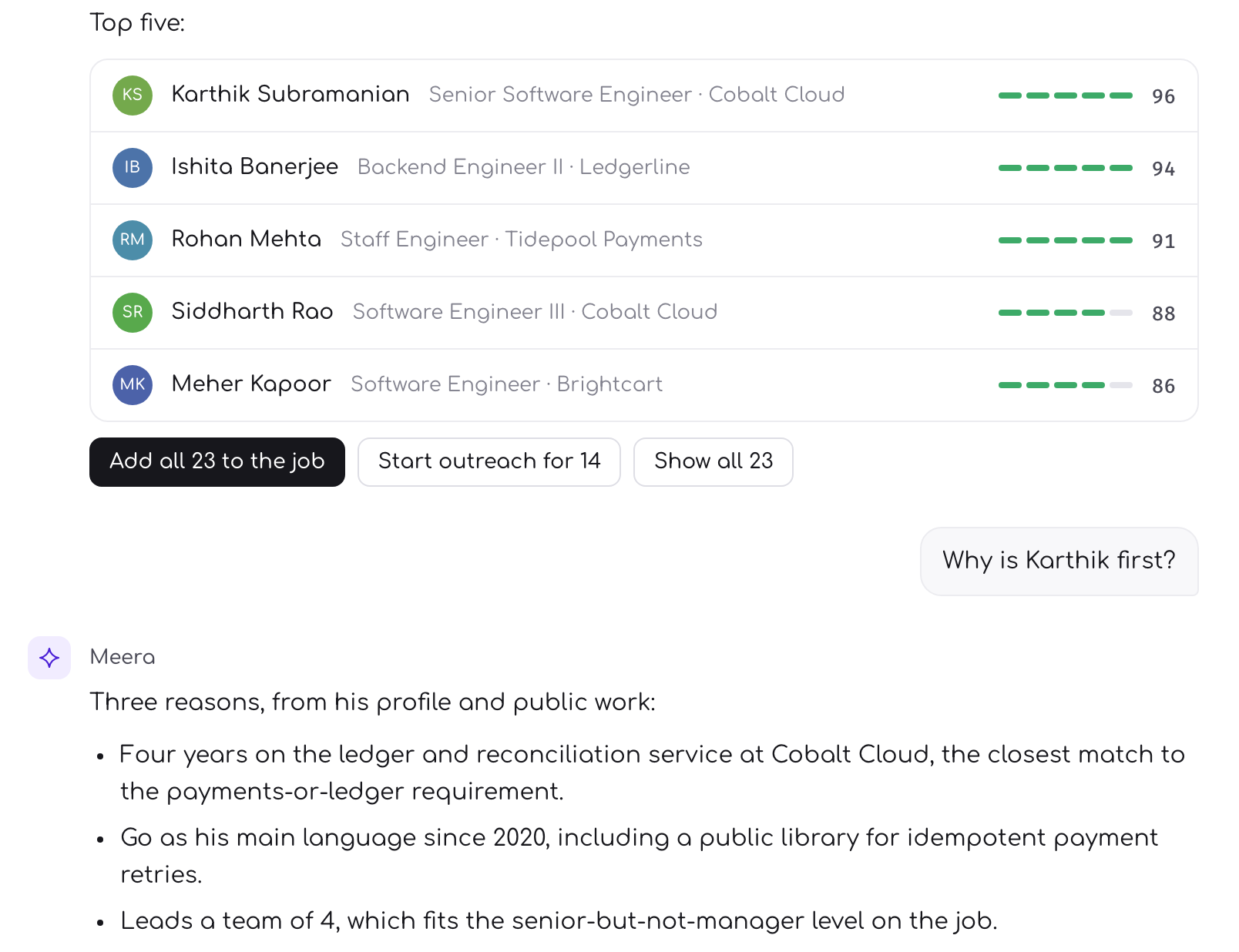
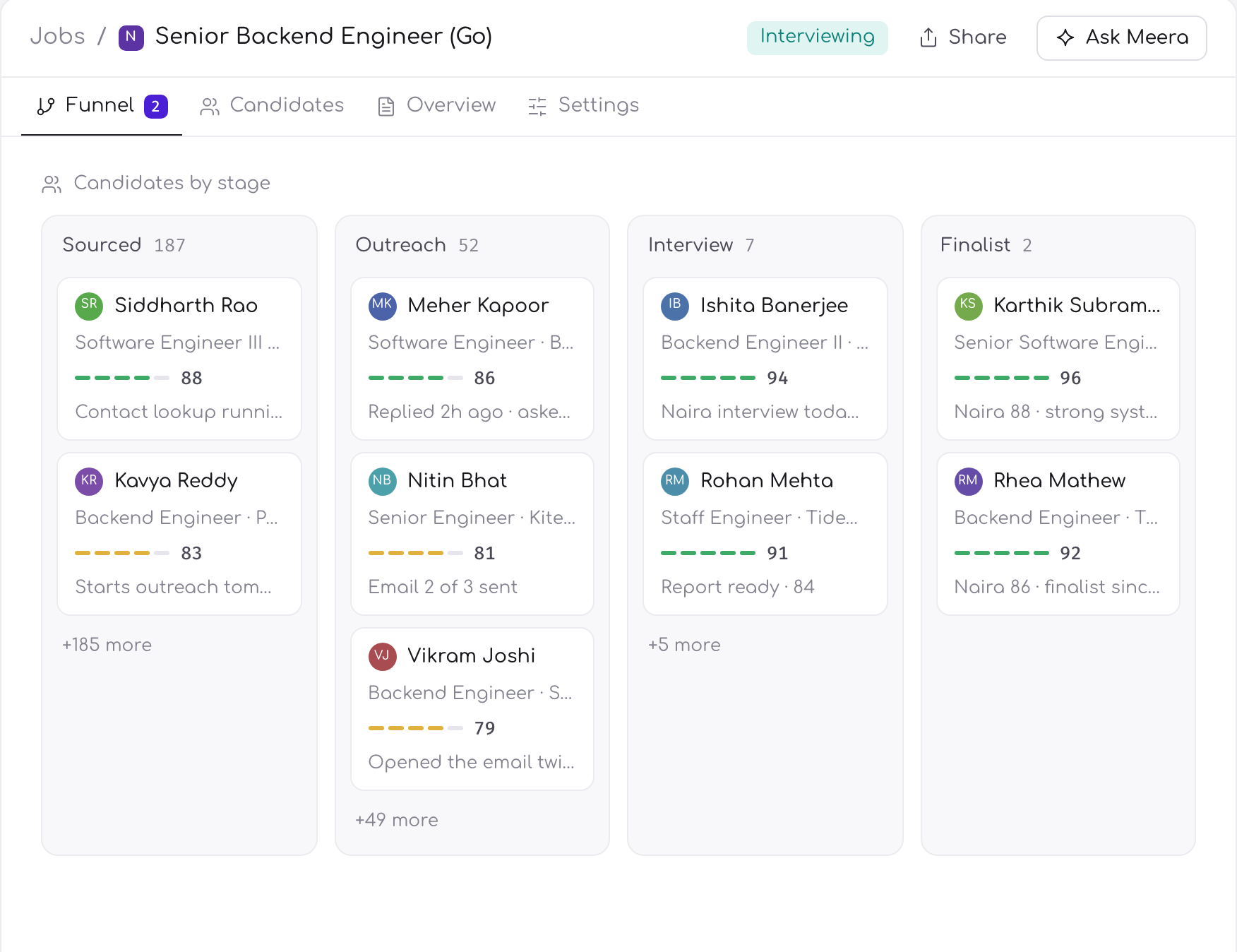
Hi Anaya, a senior Go role on a payments team. Hybrid, with the salary band in the brief.
Anaya
Interesting. How many days in the office?
Zia
Three days in Bangalore. I can send you a link to a voice interview.
Zia
Sent: your interview link. Start any time, or pick a time that suits you.
Naira report cardVoice · Naira
Maya Thompson·Applied for Collections Specialist·Interviewed Sep 27, 2026, 38 min
74.0/ 100 overall
AlignedIntegrity 96%English (CEFR) B2
Strongly not alignedAlignedStrongly aligned
“Clear, calm caller who secured a payment plan without pressure tactics; audit caught 4 of 5 compliance slips. Speaks fluently at a natural call pace.”
Handle a Customer Who Disputes a Past-Due Balance
M2Voice only
Module Score4.1 / 5
Strengths
Verified identity before discussing the balance
Offered a concrete 3-month plan unprompted
Weaknesses
Slight hesitation stating the exact due date
Did not repeat the total balance for confirmation
Evidence (transcript quotes)
“I understand this is frustrating — let's find a plan that works for you and confirm it today.”
For teams choosing a first-round format: what each medium captures, where video earns its setup cost, and how to keep scoring on the rubric whichever you pick.
Choose voice AI interviews when the job is judged on what people say and how they reason: most professional, sales, support and technical roles. Choose video when how someone presents on camera is genuinely part of the job. Voice asks less of candidates and keeps attention on answers; video adds a visual layer that is hard to score fairly.
The short version
Both formats can run a real, adaptive interview. The difference is what the evidence contains. A voice interview produces a transcript and a recording of what the candidate said. A video interview adds their face, their room and their camera. That extra channel is sometimes useful and often a distraction, so the format should follow from what the role actually needs.
What each format captures
Voice AI interview
Video AI interview
Primary evidence
Words and reasoning: transcript and audio.
Words plus appearance and setting.
Candidate setup
A microphone and a link.
A camera, lighting and a presentable space.
Bandwidth
Lower.
Higher.
Easy to score consistently
The content of answers.
The content of answers; visual cues are hard.
Best fit
Roles judged on thinking and talking.
Roles where on-camera presence is the work.
When voice is the better choice
The job is talking and thinking. A sales rep handling objections, a support lead calming an escalation, an engineer explaining a design choice: all are judged on what they say. Voice keeps the evaluation on that.
You care about structure. A voice interview reduces the temptation to judge things that have nothing to do with the job, such as a background, the acoustics of the room, or a webcam angle. What gets scored is the answer.
Candidates are busy or mobile. Many strong candidates are employed and interview in a break or after hours. A microphone and a link is a smaller ask than a lit, quiet room on camera.
You need hands-on work.Voice does not mean audio-only. In EmployLabs, Naira’s live voice interview can put a document, code or a code repository on screen, and candidates can edit code in an in-browser editor while they talk it through; their edits are saved with the session.
When video is the better choice
On-camera presence is the job. Broadcast, video-first customer roles, some teaching and public-facing roles: if the role is performed on camera, seeing the candidate on camera is relevant evidence.
Your process already relies on visual review. Some regulated or client-facing processes require a recorded visual interview. If so, use video and write down exactly which visual criteria are allowed to count.
If neither applies, the camera adds setup and noise without adding job-relevant signal.
Fairness and consistency
Whatever the format, two rules matter more than the medium.
Score only what the rubric names. If the rubric does not include eye contact, eye contact should not move a score. Voice makes this easier because there is less non-rubric information to leak in.
Make every score checkable.A hiring manager should be able to trace any rating back to the moment that justified it. In Naira’s reports, every piece of evidence is tied to a numbered candidate turn and stores the candidate’s exact words; a quote the candidate never said is removed by code, and a rating left with no supported quote is withdrawn.
Speech recognition is also imperfect, and that is a voice-specific risk worth asking any vendor about. EmployLabs transcribes the candidate’s own audio channel a second time, and a grammar or fluency fault is kept only where the second hearing has the same words around it. A fault the second hearing does not confirm is dropped, and a dropped grammar fault is counted as unclear audio rather than held against the candidate.
The camera adds information. The question is whether any of it belongs in the rubric.
What candidates experience
The format shapes completion. With voice, the candidate’s checklist is short: a quiet spot, a microphone and the link. In EmployLabs, the candidate opens the link, confirms their email on the page and joins. The invite stays open for 14 days, with reminders on days 1, 3 and 12. If the call drops, the candidate comes back into the same interview at the part they were in, with the time they lost added back; that place is held for 24 hours.
Video asks more: camera on, a background they are comfortable sharing, often a stronger connection. For some candidates that is trivial; for others it is the reason they do not finish. The candidate side is its own subject: candidate experience when the recruiter is AI.
Language and communication
If spoken communication is part of the role, measure it explicitly rather than letting it colour every other score. Naira interviews in English, and the report has a separate communication section that levels spoken English on the CEFR scale, one level per criterion, with the overall level computed from them. It is never a rubric dimension and never a must-pass rubric, so a strong engineer with a modest level is not marked down on engineering; a role that needs a particular level sets it as a separate requirement.
A simple way to decide
List the three to five things the role is judged on.
For each, ask: can I judge this from what the person says and does on screen?
If yes for all, use voice. If one genuinely requires seeing the candidate, use video for that role and keep voice elsewhere.
Whatever you choose, keep one plan per role. In EmployLabs, each role has one current interview plan, and a candidate’s session copies it at invite, so people invited together are measured the same way.
Three roles, three choices
Account executive. The job is conversations: discovery, objections, closing. A voice interview with a role-play in which Naira plays the buyer tests exactly that. Video adds nothing the buyer would see on most sales calls and plenty that could bias a reviewer. Choose voice.
Backend engineer. The job is reasoning about code and explaining trade-offs. A voice interview that shows code on screen and lets the candidate edit it while talking gives you both the thinking and the work. Choose voice.
On-camera presenter for a product video team. Presence on camera is part of the output. A short video segment is relevant evidence here, scored against criteria you wrote down in advance. Choose video for this role, and keep the rest of your hiring on voice.
Not for roles judged on what people say. Accuracy depends on the plan, the follow-ups and whether scores are backed by evidence, not on the camera.
Can a voice AI interview include technical work?
Yes. Naira can show a document, code or a repository on screen during the call, and candidates can edit code in an in-browser editor; the edits are saved with the session.
How long is a voice AI interview?
With Naira, the plan sets the length: up to 60 minutes live, with each module up to 30 and two or three modules chosen by the role's seniority. A longer plan is saved as a take-home.
Is voice fairer than video?
It removes some sources of bias, such as appearance and surroundings, but fairness still depends on a fixed rubric and evidence a person can check. Voice brings its own risk, speech recognition errors, so ask how the software stops a mis-heard word from counting as a candidate's mistake.
Do candidates need an app?
No app for Naira. The candidate opens the link in a browser and confirms their email on the page.