Hi Anaya, a senior Go role on a payments team. Hybrid, with the salary band in the brief.
Anaya
Interesting. How many days in the office?
Zia
Three days in Bangalore. I can send you a link to a voice interview.
Zia
Sent: your interview link. Start any time, or pick a time that suits you.
Naira report cardVoice · Naira
Maya Thompson·Applied for Collections Specialist·Interviewed Sep 27, 2026, 38 min
74.0/ 100 overall
AlignedIntegrity 96%English (CEFR) B2
Strongly not alignedAlignedStrongly aligned
“Clear, calm caller who secured a payment plan without pressure tactics; audit caught 4 of 5 compliance slips. Speaks fluently at a natural call pace.”
Handle a Customer Who Disputes a Past-Due Balance
M2Voice only
Module Score4.1 / 5
Strengths
Verified identity before discussing the balance
Offered a concrete 3-month plan unprompted
Weaknesses
Slight hesitation stating the exact due date
Did not repeat the total balance for confirmation
Evidence (transcript quotes)
“I understand this is frustrating — let's find a plan that works for you and confirm it today.”
For hiring teams meeting the term for the first time: what an AI interviewer does, how a session runs from plan to report, what it should never do, and how to judge one before a pilot.
An AI interviewer is software that holds a live interview with a candidate, asks follow-up questions, and scores the answers against a rubric your team sets. Good ones use the same plan for every candidate, show the evidence behind each score, and leave the hiring decision with people. Most run by voice or video in a browser.
What an AI interviewer is
An AI interviewer is a system that conducts a structured job interview in real time, adapts its follow-up questions to what the candidate says, and produces a report that scores each part of the interview against a rubric set before anyone was interviewed, with evidence drawn from the candidate’s own words.
It is different from three tools it is often confused with:
One-way video interviews record answers to fixed questions. Nobody asks a follow-up.
Chat screeners check basic qualifications such as location, availability or a licence. They do not test how someone thinks.
Interview note-takers record and summarise interviews that people run. The person is still the interviewer.
An AI interviewer sits where the first-round screening call used to be: a real conversation, with follow-ups, that ends in a written assessment.
How an AI interviewer works, step by step
The plan is built from the role. The interviewer reads the job description and the must-haves, then builds an interview plan: which areas to test, which questions open each area, and what a strong answer contains.
The rubric is fixed before anyone is interviewed. Each area gets scoring criteria. Every candidate for the role is measured against the same rubric, which is what makes the results comparable.
The candidate joins from a link. In a voice interview, the candidate opens a link, confirms their email on the page, and talks.
The conversation adapts. When an answer is vague, the interviewer asks for an example. When it is strong, it goes deeper. This is the main difference from fixed-question formats.
Hands-on work where the role needs it. For some roles, the candidate reviews a document, triages a scenario or reads code during the interview.
The report is written. Each area is scored, and each score points to the parts of the transcript that justify it.
A person decides. The hiring team reads the report and decides who moves on.
What Naira, the EmployLabs AI interviewer, does
Naira runs a live voice interview, in English, from a link the candidate opens in the browser after confirming their email on the page. Each role has one current interview plan with four to seven rubric dimensions, some of which can be marked must-pass. The seniority of the role picks the modules: two or three of artifact audit, scenario triage, system design and improve the artifact. A candidate’s session copies the plan at the moment they are invited, so edits to the plan reach only new invites, and candidates invited together are measured the same way.
A live interview runs up to 60 minutes, with each module up to 30 and the warm-up, close and candidate questions up to 15 each. A plan that would run longer than 60 minutes is saved as a take-home instead. If the call drops, the candidate comes back into the same interview at the part they were in, with the time they lost added back; that place is held for 24 hours. Technical candidates can read and edit code in an in-browser editor, and their edits are saved with the session; other modules put a document or a code repository on screen, or cast Naira as a counterpart in a role-play.
The reportopens on a recommendations block with the verdict and a summary, an overall score and an alignment level, then a score for each module, and a separate communication section that levels spoken English on the CEFR scale, one level per criterion. Every piece of evidence is tied to a numbered candidate turn and stores the candidate’s exact words; a quote the candidate never said is removed by code, and a rating left with no supported quote is withdrawn. If the grader cannot grade at all, the report says “Not graded — review the transcript” and the decision goes to a person.
A score that cannot be traced to what the candidate said cannot be defended to a hiring manager.
What an AI interviewer should never do
Decide alone. It should recommend and explain; people make hiring decisions.
Score without evidence. A score that cannot be traced to what the candidate said cannot be defended.
Change the questions between candidates for the same role. Consistency is the point.
Hide that it is AI. Candidates should know who, or what, they are talking to.
Penalise for things unrelated to the job, such as accent, background noise or camera quality.
When an AI interviewer helps most
Many applicants, few interviewers. Every applicant can get a real first conversation instead of a CV skim.
Hiring across time zones. Candidates interview at midnight or on a Sunday if that suits them.
Inconsistent first rounds. When five interviewers ask five different sets of questions, one rubric fixes calibration.
Hiring managers who want evidence. A report with quotes is faster to act on than notes from a phone screen.
It helps least when the role depends on a relationship built over several conversations, such as a senior executive search. There, use it for structured skill checks, not the whole process.
How to evaluate an AI interviewer
Question
What a good answer looks like
What Naira does
Is the interview two-way?
It asks follow-ups based on the answer.
Follow-ups adapt to each answer; a vague one is asked for an example.
Is the rubric fixed per role?
One current plan per role, copied into each session at invite.
One plan per role; a session copies it when the invite is minted.
Is every score explained?
Evidence stores the candidate's own words.
Each quote resolves to a numbered candidate turn or is dropped.
Who decides?
A person, always.
The report recommends; your team moves the candidate.
How do candidates join?
A link, with no app or account.
A link in the browser, with the email confirmed on the page.
What if the call drops?
The session resumes where it stopped.
Same interview, same place, lost time added back, for 24 hours.
What if it cannot grade?
It says so and hands over to a person.
The report reads not graded and a person reviews the transcript.
Then run a pilot: take one live role, invite ten candidates, read every report, and ask the hiring manager whether the reports match their own judgement on the candidates they also met. The scoring rubric itself is worth reading first; behavioural anchorsare what make two interviewers’ scores comparable.
Voice or video?
Voice keeps the focus on what the candidate says and removes camera anxiety and bandwidth problems. Video adds visual information that most rubrics should not score anyway. For most first-round interviews, voice is enough, and candidates find it easier to take from anywhere. The format decision has its own write-up: voice vs video AI interviews.
How an AI interviewer fits with the rest of hiring
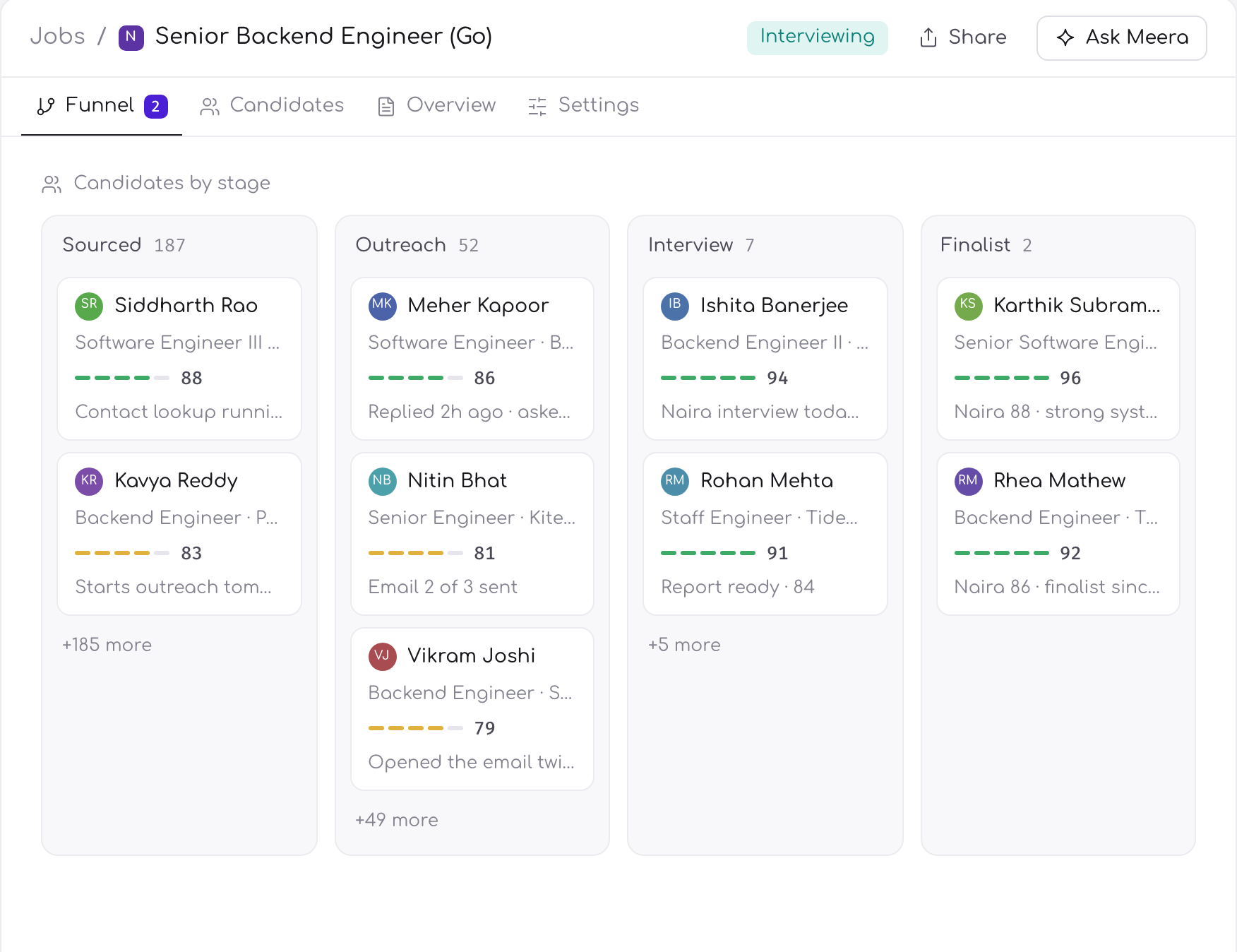
An AI interviewer works best after sourcing and outreach and before the hiring manager’s interview. In EmployLabs, Meera finds and scores candidates, Zia reaches them on email, WhatsApp, SMS, calls, X and Reddit, an interested reply leads to an interview invite (sent automatically or after a person approves it), and Naira runs the interview. Nothing runs on its own until a person activates the role.
Software that runs a live, structured interview with follow-up questions and writes a report scoring each answer against a rubric, with evidence from the transcript.
Is an AI interviewer the same as a one-way video interview?
No. A one-way video records answers to fixed questions. An AI interviewer holds a two-way conversation and asks follow-ups.
Does an AI interviewer make the hiring decision?
It should not. In EmployLabs, Naira writes the report and your team decides.
Does the report assess spoken English?
Yes. A separate communication section levels spoken English on the CEFR scale, one level per criterion, with an overall level computed from them. It is never a rubric dimension and never a must-pass rubric; a role can set a required level separately.
How long is an AI interview?
With Naira, the plan sets the length. A live interview runs up to 60 minutes, each module up to 30, and the role's seniority picks two or three modules. A plan that would run longer is saved as a take-home.
How long do candidates have to take it?
An invite stays open for 14 days, with reminders on days 1, 3 and 12.