Hi Anaya, a senior Go role on a payments team. Hybrid, with the salary band in the brief.
Anaya
Interesting. How many days in the office?
Zia
Three days in Bangalore. I can send you a link to a voice interview.
Zia
Sent: your interview link. Start any time, or pick a time that suits you.
Naira report cardVoice · Naira
Maya Thompson·Applied for Collections Specialist·Interviewed Sep 27, 2026, 38 min
74.0/ 100 overall
AlignedIntegrity 96%English (CEFR) B2
Strongly not alignedAlignedStrongly aligned
“Clear, calm caller who secured a payment plan without pressure tactics; audit caught 4 of 5 compliance slips. Speaks fluently at a natural call pace.”
Handle a Customer Who Disputes a Past-Due Balance
M2Voice only
Module Score4.1 / 5
Strengths
Verified identity before discussing the balance
Offered a concrete 3-month plan unprompted
Weaknesses
Slight hesitation stating the exact due date
Did not repeat the total balance for confirmation
Evidence (transcript quotes)
“I understand this is frustrating — let's find a plan that works for you and confirm it today.”
Naukri AI REX sources, calls and screens candidates from Naukri's jobseeker database and ends at a shortlist with interviews scheduled. EmployLabs searches professional-profile data beyond any job board, judges each must-have on evidence, and ends at a structured voice interview with a report. Choose AI REX when the right people are active on Naukri; choose EmployLabs when they are not.
Two products doing much of the same work
Naukri’s AI REX is the product closest to what we do. Naukri describes it as an agentic AI talent-sourcing platform, introduced in April 2026, that takes a requirement from job opening to shortlist. The recruiter enters the designation, location, skills, experience and salary; AI REX shows sample matches, learns from Good fit, Maybe and Not a fit feedback, writes the job description and an editable screening questionnaire, then calls, messages and screens candidates from the Naukri database.
AI REX works the people already on Naukri and ends at a shortlist. EmployLabs searches beyond any job board and ends at an interview report.
Which one you need
The right people are active on Naukri. Mid and junior roles, roles outside the metros, functions where good candidates keep a current profile and answer a call about a new job. AI REX is working the database those people are already in, and that is the right place to start.
The right person is not looking. A senior engineer who has not updated a job-board profile in years, a specialist whose whole market is a few companies, a role where the people who could do it are not on any job board. Here the database is the limit, and working it harder does not move it.
You need evidence, not just a shortlist. When the hiring manager wants to know how a candidate reasons through a problem before giving up an hour, a screening questionnaire answers a different question from the one being asked.
If every role you hire for sits in the first group, AI REX is built for you and you can stop reading here.
What you end up with
Outcome
Naukri AI REX
EmployLabs
What lands on your desk
A shortlist of Naukri candidates who were matched, called to check interest, screened on your questions and scheduled for interview, shared with the hiring manager for review.
Candidates found across professional-profile data and our own jobs board, contacted, screened and interviewed by voice, each arriving with a report that quotes what they said.
What you still do yourself
The interviews, and the judgement of who is genuinely strong once the shortlist arrives.
Arm the role with its scope and caps, answer the interventions that need judgement, then the hiring-manager conversation, the client rounds and the decision.
Time to the first useful thing
Sample matches as soon as the requirement is entered, from a database that is already there.
A sample of real profiles before anything is sourced at volume; interviewed candidates follow once people have been found and reached.
What you keep afterwards
A shortlist and the calibration you gave the matching for that requirement.
The pool, the scoring with its evidence, the interview reports and a decision record for every automated step.
Where it fails you
When the person you need is not active on Naukri. Matching can only rank the database it searches.
When the brief is wrong. Aimed at a badly specified role it produces confident activity and no hires, which is why the sample comes first.
What each one can actually do
Outcomes are what you end up with. This is the work itself, job by job. Where Naukri’s published product material does not describe a capability, the row says so rather than reading an absence into it.
Finding and deciding
Naukri AI REX
EmployLabs
Turn the brief into a requirement
The recruiter enters designation, location, skills, experience and salary; AI REX generates the job description and an editable screening questionnaire from it.
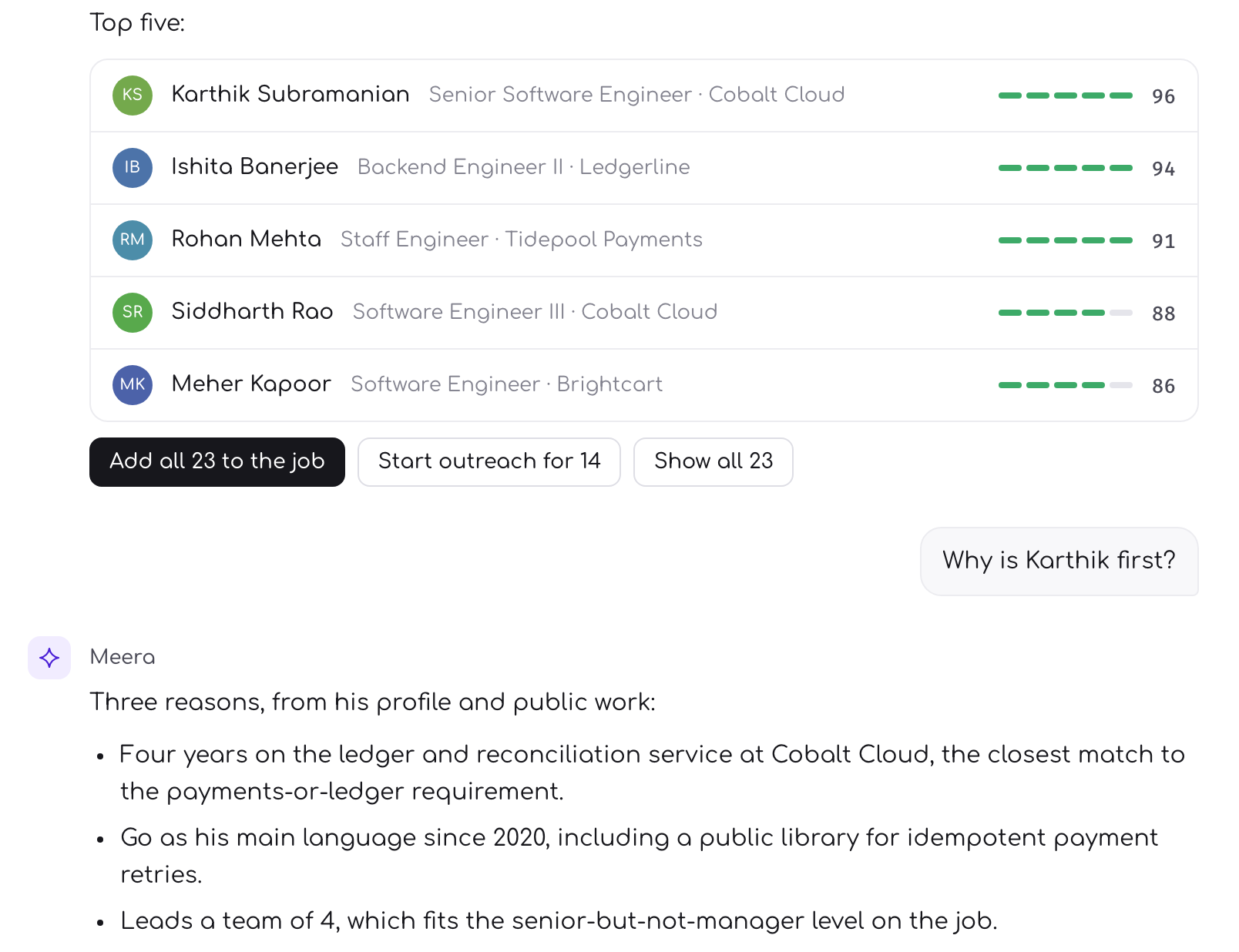
Meera, the recruiter copilot, turns the job description into one role definition that drives both the search and the scoring. Each must-have is recorded once in the JD's own words and marked as checkable from the profile or only from the candidate.
Calibrate before anything runs at volume
Sample matches are shown up front, and Good fit, Maybe and Not a fit feedback refines the matching in the product.
Meera proposes several sourcing strategies and the recruiter previews a sample of real profiles for each. Automation will not source from a strategy nobody sampled.
Find the candidates
Matched from the Naukri database, including high-potential candidates surfaced before they apply. Sourcing outside Naukri's own database is not described in published product material.
People search across major professional-profile data providers, reaching people who are on no job board, in a pool that pages forward and never buys the same person twice. Applicants from our own jobs board go through the same scoring.
Judge a must-have
AI-screened applications based on the recruiter's questions.
Each must-have is judged three ways: met, contradicted or not stated, with the evidence line attached. Only positive evidence of a mismatch disqualifies. Silence becomes a question put to the candidate, never a reject.
Rank the people who pass
Matching refined by the recruiter's feedback on sample candidates.
Seven anchored, role-specific dimensions, from skill match and ownership to domain depth and company background. Change the brief and everyone it can affect is re-scored automatically.
Reaching, assessing, handing over
Naukri AI REX
EmployLabs
Reach the candidate
Automated calling that pitches the role and checks interest, with a pitch the recruiter edits and can test-call; email, WhatsApp, the Naukri inbox, app notifications and job posts.
A four-email sequence over a week: a personalised first email, a same-thread follow-up, a new-angle email and a closing note. Once the email has provably reached the candidate, and their number is Indian, one AI phone call within TRAI calling hours. Recruiters can add LinkedIn invites through a browser extension they operate.
Hold the conversation
The calling agent pitches the role from a pitch the recruiter edits and checks interest; messages continue on WhatsApp, the Naukri inbox and app notifications.
Zia, one conversational engine across email, WhatsApp, phone and web. It knows each candidate's strengths and gaps, answers questions about the role, uses India salary benchmarks by role, city and seniority, and asks the must-haves the profile never settled.
Interview the candidate
Interviews are scheduled with shortlisted candidates. A structured AI interview producing an evidence report is not described in published product material.
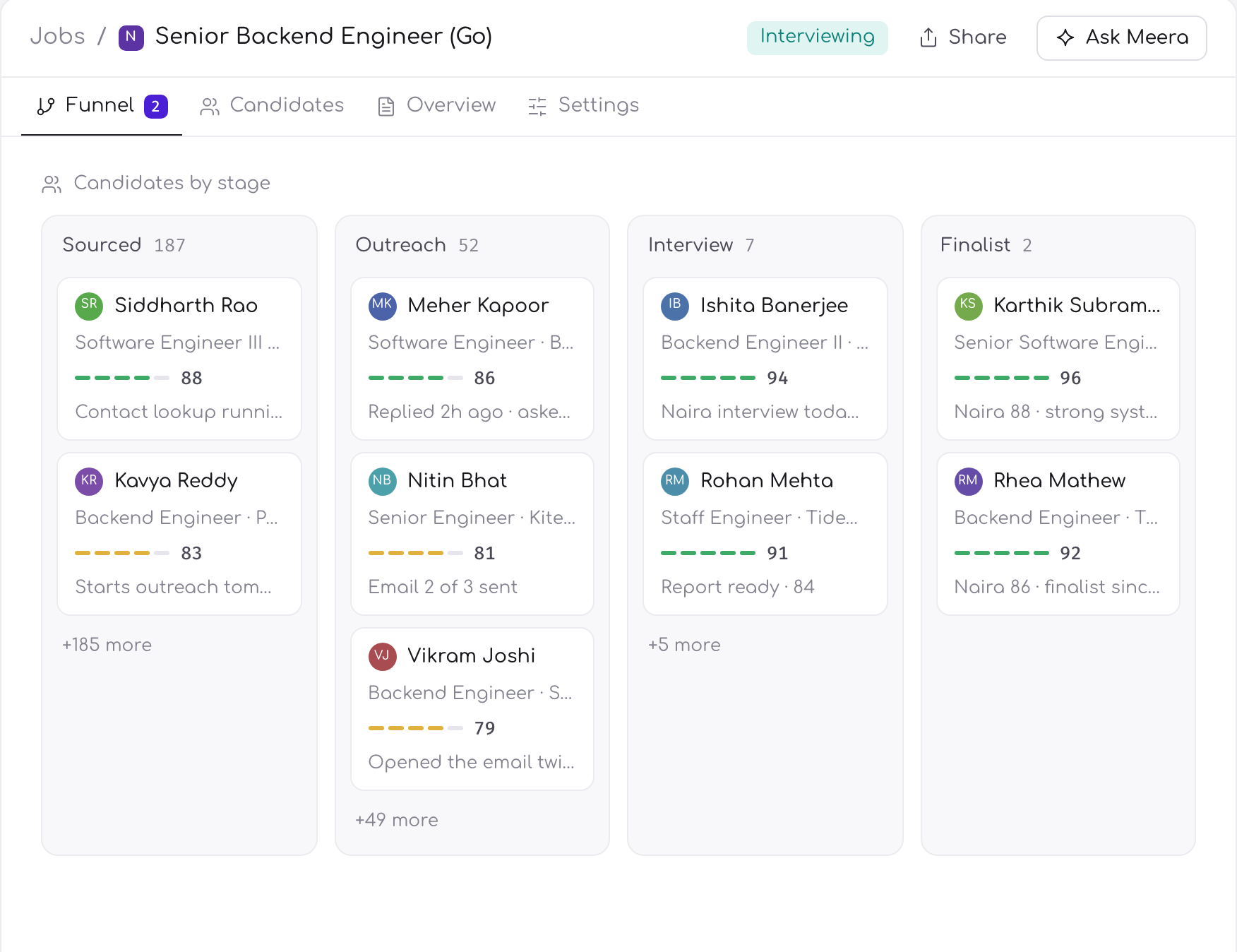
Naira runs a browser voice interview, multi-module with phases enforced. Technical candidates write code in a live editor and explore a real repository with Naira, who reads and discusses it; non-technical roles get document-based exercises.
Give the hiring manager something to act on
The shortlist is shared for hiring-manager review, with automated reminders.
A five-level alignment rank with written rationale, spoken-English level on the CEFR scale, skill depth with the candidate's own quotes, and risks with a severity, on a share link only the people you name can open.
Flow into your ATS
Naukri's own RMS sits alongside it. AI REX integration with external ATSs is not described in published product material.
One live connector, Zwayam, submitting finalists with a generated CV into the client's portal after a dry run. Other ATS connectors are not built.
What actually arrives
For each finalist, the hiring manager opens the interview report on the share link: an alignment rank on a five-level scale with the written rationale behind it, the candidate’s spoken-English level on the CEFR scale with its criteria, skill depth per skill with the candidate’s own quotes, and the risks, each with a severity. Topics the interview never probed are marked “Not assessed” rather than guessed.
What it costs you to find out
Start on one role, with nothing to integrate. Nothing runs until somebody arms it, choosing the scope and the caps on sourcing, finalists and spend, and you can stop at any time with the pool, the scoring and the reports still yours.
Where AI REX wins
A database of active Indian jobseekers, its own. At India scale, and with people who want to be contacted. Nothing we search replaces that, unless the person you need has not touched a job-board profile in years, as is often the case in senior and specialist hiring.
Native WhatsApp outreach and automated calling. Both built in, with the Naukri inbox and app notifications behind them. Our outreach is a four-email sequence with one AI call for Indian numbers once the email has reached them, and Zia continues on email or WhatsApp once a candidate engages. Theirs is the wider first-contact toolkit, unless the people you need are not on Naukri to begin with.
A feedback loop for calibration, in the product. Good fit, Maybe and Not a fit is a fast way to teach the matching. Ours is the sample and the edited brief, which re-scores the pool; the difference is one of style unless your recruiters want to calibrate by clicking.
A hiring-manager review workflow with reminders. Built for the review step and for chasing it. Ours is a share link with the full role behind it, so theirs is the better fit if your hiring managers need chasing to review.
Where Indian candidates already are. For mid and junior roles outside the metros, Naukri is the default place people look for work. That is genuinely theirs, unless the role is one where the right person is not looking at all.
Running both, concretely
For an Indian team hiring across levels this is a sensible configuration, and it is operational rather than diplomatic. Put AI REX on the requirements where active jobseeker volume is the answer: the mid and junior roles, the regional hiring, the positions where the right candidate has a current Naukri profile and wants the call. AI REX is sold per requirement, one position with an allocation of CVs, which makes that split natural.
Put EmployLabs on the roles where the right person is not on a job board, and on the ones where the hiring manager needs interview evidence before spending an hour. Nothing runs until a person arms the role and sets its scope and caps, so splitting requirements between the two is a decision per role, not a migration. If your client runs on Zwayam, finalists from our side reach its portal with a generated CV.
What a TA lead actually wants to know
Can I run this on Monday? Both, on one requirement. AI REX starts from a database you can already see; we start from a sample of real profiles you approve before any sourcing at volume.
What happens when the brief is wrong? With AI REX, the feedback on sample matches pulls it back. With us, the sample shows it first, and editing the brief re-scores everyone it can affect without starting over.
What do I tell my hiring manager? With AI REX, here is a screened shortlist to review. With us, here is how each finalist answered in a structured interview, with their words quoted and the risks graded.
Who owns the candidate relationship? Both put an AI in front of the candidate on your behalf. The difference is whether that candidate was already looking.
What compliance artifacts can you produce today, dated, and by which auditor? Ask both and read the answers literally. Ours is structural: one rubric on every candidate, a person at the final gate and an append-only record of every automated decision and human override, with third-party audit artifacts on the roadmap.
The decision, stated plainly
If the people you need are active on Naukri, AI REX is the nearest thing to an AI recruiter working inside the database where Indian jobseekers already are, and it is the right tool. If the person you need is not on a job board, or the hiring manager needs to see how candidates think before meeting them, EmployLabs searches beyond the database, judges every must-have on evidence, and ends at an interview report rather than a shortlist. Our sourcing is global, with India-specific compensation intelligence in addition.
Common questions
What is the difference between Naukri AI REX and EmployLabs?
Naukri AI REX matches, calls and screens candidates from Naukri's own database and ends at a shortlist. EmployLabs searches professional-profile data beyond job boards, judges each must-have as met, contradicted or not stated, and ends at a structured voice interview with a report for the hiring manager.
When should a recruiter choose Naukri AI REX?
When the right candidates are active on Naukri: mid and junior roles, roles outside the metros, and positions where people keep a current profile and want the call. Its own jobseeker database, native WhatsApp and calling, and in-product feedback loop are genuine strengths there.
Does EmployLabs interview candidates, or only shortlist them?
EmployLabs interviews them. Naira runs a multi-module browser voice interview with phases enforced, including a live code editor for technical roles and document exercises for others, and returns a five-level alignment rank with rationale, a CEFR spoken-English level, skill depth with quotes and graded risks.
Can you use Naukri AI REX and EmployLabs together?
Yes. Put AI REX on requirements where active jobseeker volume is the answer, and EmployLabs on roles where the right person is not on a job board or the hiring manager needs interview evidence. Each role is armed separately, so the split is a decision per requirement.