Hi Anaya, a senior Go role on a payments team. Hybrid, with the salary band in the brief.
Anaya
Interesting. How many days in the office?
Zia
Three days in Bangalore. Want a voice interview this week?
Zia
Booked: interview Thursday 16:30
Naira report cardVoice · Naira
Maya Thompson·Applied for Collections Specialist·Interviewed Sep 27, 2026, 38 min
74.0/ 100 overall
AlignedIntegrity 96%English (CEFR) B2
Strongly not alignedAlignedStrongly aligned
“Clear, calm caller who secured a payment plan without pressure tactics; audit caught 4 of 5 compliance slips. Speaks fluently at a natural call pace.”
Handle a Customer Who Disputes a Past-Due Balance
M2Voice only
Module Score4.1 / 5
Strengths
Verified identity before discussing the balance
Offered a concrete 3-month plan unprompted
Weaknesses
Slight hesitation stating the exact due date
Did not repeat the total balance for confirmation
Evidence (transcript quotes)
“I understand this is frustrating — let's find a plan that works for you and confirm it today.”
SeekOut's agents find, rank and email candidates alongside your recruiters. EmployLabs carries the same candidate through the conversation and a voice interview. Which you need depends on where your process actually stalls.
SeekOut runs AI agents alongside recruiters that build a rubric, search public and ATS data, score candidates with reasoning and send personalised email. EmployLabs carries candidates further: it sources and emails them, calls Indian numbers, holds the conversation across email, WhatsApp, phone and web, and interviews them by voice. Choose SeekOut for recruiter-led sourcing; EmployLabs when screening and interviews stall.
Two different jobs
SeekOut describes itself as AI agents that find, evaluate and engage candidates, working alongside your recruiters inside the SeekOut platform. Its agents build a hiring rubric from your criteria, search public candidate data together with your own ATS data, score every candidate against that rubric with the reasoning shown, and write and send personalised email. The recruiter sets the criteria, decides how much the agents do on their own, approves at the critical steps.
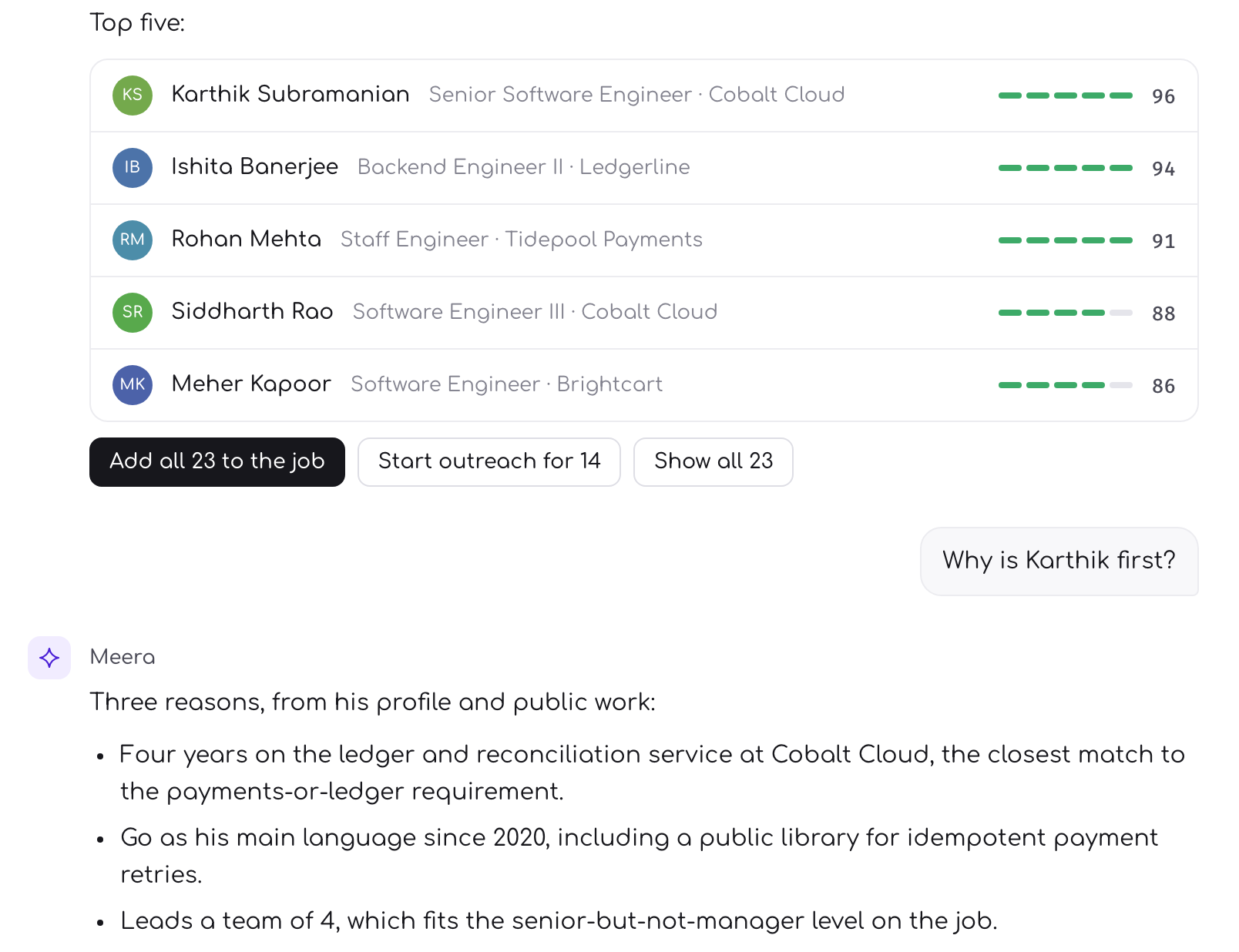
EmployLabs runs the role through to an interview. A job description becomes one role definition that drives both the search and the scoring; the system then finds the people, reaches them with a four-email sequence and, for Indian numbers, an AI phone call, holds the conversation with them across email, WhatsApp, phone and web, and interviews them by voice in the browser. What comes back is a report per candidate, not a ranked list.
The distinction is where each product stops. SeekOut’s agents take a candidate as far as a scored profile and an email in their inbox, and your recruiters take it from there. Ours carry the same candidate through the reply, the questions, the unverified requirements and a structured interview before anybody on your side has to spend an hour.
Which one you need
Your recruiters want a sharper instrument.They run their own searches, own every conversation and want the platform to find, rank and draft faster, inside a workspace they already know, reachable from the AI assistant they already use. That is SeekOut’s design, and it is a good one.
The work that matters is everything after the list. Follow-ups, phone screens and first-round interviews are where a role is won. More ranked profiles change nothing there. That is the work EmployLabs takes on, and it multiplies what each recruiter can carry rather than speeding up one step of it.
If your process ends at a well-ranked shortlist that your own team will screen, you can stop reading and buy the sourcing platform. If you want the screening and first interviews carried for you, read on.
Outcome
SeekOut
EmployLabs
What lands on your desk
Candidates found across public data and your ATS, each scored against a rubric built from your criteria with the reasoning shown, and personalised emails already sent.
Candidates found, contacted, questioned on the requirements their profile left open and interviewed by voice, each with a report carrying an alignment rank, skill depth with quotes and the risks.
What you still do yourself
The conversation once a candidate replies, the phone screen, the interview and the final decision, with approvals at the steps you choose.
The decision: reading the report, the hiring-manager conversation, client rounds and the offer, plus any intervention the system raises for a judgement.
Time to the first useful thing
As soon as the rubric is set and the search runs inside the platform.
Days on one role: a sample of real profiles before any volume is sourced, then contact and interviews.
What you keep afterwards
The rubric, the scored pool and your rediscovered past applicants, inside the platform your team works in.
The pool, the scoring with its evidence, every conversation and every interview report, for this role and the next.
Where it fails you
Capacity. A ranked, contacted pool still needs recruiter hours to become interviewed candidates.
A brief nobody thought hard about. Aimed at a badly specified role, it interviews the wrong people well.
What each one can actually do
Job by job, because a requirement list needs to know which boxes each product genuinely fills. Where SeekOut’s published product material does not describe a capability, the row says so rather than reading an absence into it.
Job in the hiring process
SeekOut
EmployLabs
Turn your criteria into something a machine can judge
Rubric Creator builds a hiring rubric from the criteria you give it, and every candidate is evaluated against it.
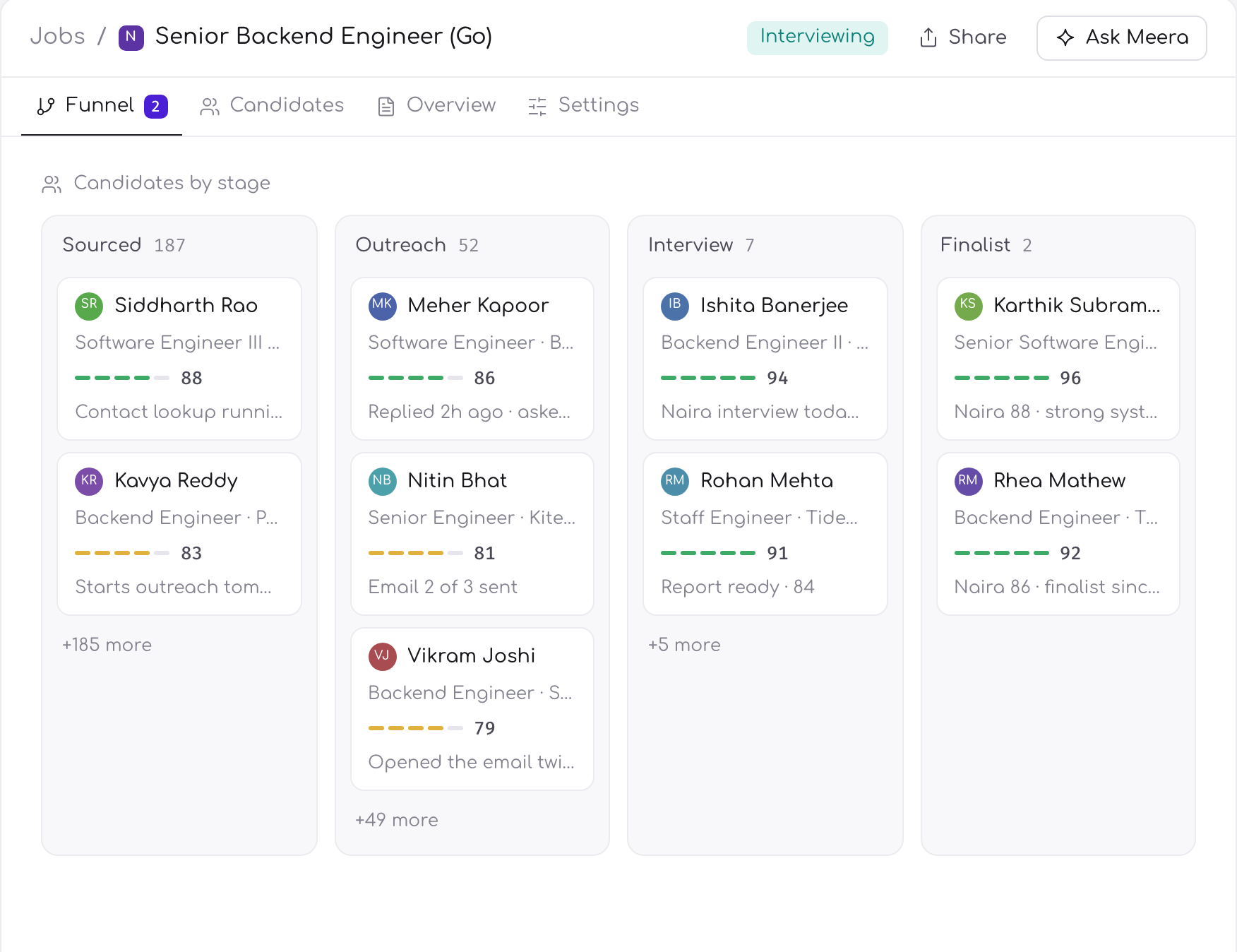
Meera, the recruiter copilot, turns the job description into one role definition that drives the search and the scoring. Each must-have is recorded once in the JD's own words and marked as checkable from the profile or only from the candidate.
Check the search before it runs at volume
Not described in published product material.
Meera proposes sourcing strategies and you preview a sample of real profiles for each before anything is sourced at volume; automation will not source from a strategy nobody sampled.
Find candidates for the role
Candidate Finder searches public candidate data together with your ATS data across a large external profile set, with rediscovery of past applicants and a Chrome extension.
People search across major professional-profile data providers with a fallback provider, in a pool that pages forward and never buys the same person twice; public-board and Zia-run applicants go through the same scoring.
Score a candidate and show why
Candidates are scored against the rubric with the reasoning shown.
Each must-have is judged met, contradicted or not stated, and only evidence of a mismatch disqualifies. Seven anchored, role-specific dimensions are scored, every judgement carries its evidence line, and changing the brief re-scores the people it affects.
Screen inbound applicants
Applicant evaluation and AI screening of inbound applicants, with fraud flagging.
Zia-run apply sessions read the résumé, ask mandatory screening questions and score the applicant against the same role definition as sourced candidates.
Make first contact
Outreach Expert writes personalised messages and sends emails. SMS, WhatsApp and phone outreach are not described in published product material.
A four-email sequence over a week — a personalised first email, a same-thread follow-up, a new angle, a closing note — and, once an email has provably reached a candidate with an Indian number, one AI phone call inside TRAI calling hours. Recruiters can send LinkedIn invites through a browser extension they operate; outside India, first contact is the email sequence, and Zia continues on email or WhatsApp once a candidate engages.
Hold the conversation
Not described in published product material beyond sending the outreach.
Zia, one conversational engine across email, WhatsApp, phone and web, knows the candidate's strengths and gaps, answers questions about the role and asks the must-haves the profile left unverified. A candidate who replies leaves the sequence at once.
Interview the candidate
AI or voice interviews are not described in published product material.
Naira runs a multi-module browser voice interview with phases enforced by a conductor. Technical candidates write code in a live editor and explore a real repository, read and discussed with them; non-technical roles get document exercises.
Schedule
Not described in published product material.
Per-candidate client interview rounds, and offers sent with accept and decline links.
Give the hiring manager something to act on
The scored candidates and their reasoning inside the platform.
A share link for the whole role — board, candidates, interviews, outreach history — with no EmployLabs seat; only people you name can open it, and links expire and can be revoked.
Decide how much runs on its own
The recruiter decides how much the agents do autonomously and approves at critical steps.
Nothing runs until a person arms the role with a scope and caps on sourcing, finalists and spend; it then works to those limits and raises typed interventions when a judgement is needed.
Work from your AI assistant
SeekOut MCP brings its profile data into mainstream AI assistants.
Not offered. Recruiters work in the EmployLabs board and with Meera.
Flow into your systems
ATS, CRM and HCM integrations listed on a partners page.
One live connector, Zwayam, which submits finalists with a generated CV into the client's portal after a dry run. Greenhouse, Lever and Workday connectors are not built.
Produce compliance artefacts
Publicly stated SOC 2 Type 2 and ISO/IEC 42001 AI-management compliance.
One rubric on every candidate, a person at the final gate, and an append-only record of every automated decision and override.
A scored profile tells you who to talk to. An interview report tells you what they said.
What SeekOut does that we do not
One search across a large external profile set and your ATS together. Candidate Finder reads your own applicant history alongside public data, and rediscovers past applicants as it goes. Our search runs across professional-profile providers and our own inbound applicants, which is what you want when the role is one your ATS has never seen a candidate for.
Rubric-based evaluation with explanations, at the profile stage. A rubric built from your criteria and reasoning on every score is a real strength, and it is the right instrument when your recruiters want to make each call themselves. It stops being the deciding factor when the bottleneck is the interview rather than the ranking.
Access from the AI assistant you already use.SeekOut MCP brings its profile data into mainstream assistants. That counts most when your team’s working day is in a chat window; ours is built around the recruiting board and Meera.
Fraud flagging on inbound applicants. Named, published and built in. Our inbound screening reads, questions and scores every applicant against the role. Dedicated fraud flagging weighs most for high-volume public postings, less for targeted specialist searches.
Stated compliance certifications. SeekOut publicly states SOC 2 Type 2 and ISO/IEC 42001 AI-management compliance. If your procurement needs those on file this quarter, that answer is theirs.
Breadth of integration. ATS, CRM and HCM partners are listed; we have one connector, Zwayam. Unless your client portal is Zwayam, finalists reach your system of record the way any externally sourced candidate does today.
Running both, concretely
The configuration that makes sense splits the work at the reply. Your recruiters keep SeekOut for the searches they want to run by hand and for rediscovering past applicants. A role where contact, screening and first interviews are the constraint goes to EmployLabs as a brief, armed with its own caps, and comes back as interview reports on a share link your hiring manager can open without a seat. Neither product needs the other to work, and the mistake is buying either expecting the other: a sourcing platform will not interview anybody, and we will not search your ATS history.
What a TA lead actually wants to know
Can I run this on Monday? SeekOut, once the rubric is set up. EmployLabs, on one role: brief, sample, arm.
Which part of my week gets better? With SeekOut, finding and first contact. With EmployLabs, the follow-ups, screens and first interviews after it.
What do I tell my hiring manager? With SeekOut, your summary of a scored list. With us, a link to the interview reports themselves.
What happens when the brief is wrong? On both, the rubric or role definition is the lever. On ours, changing it re-scores the affected candidates automatically, and a requirement the profile cannot answer becomes a question to the candidate rather than a reject.
What compliance artefacts can you produce today, dated, and by which auditor? SeekOut states SOC 2 Type 2 and ISO/IEC 42001. We produce the decision record and the single rubric, with third-party artefacts on the roadmap. Ask both of us and read both answers literally.
The decision, stated plainly
Choose SeekOut if your recruiters want to keep every conversation and need a faster, better-explained way to find, rank and email candidates, from inside its platform or their AI assistant, with certifications on file. Choose EmployLabs if you want the work after the list — the follow-up, the questions, the screen and the first interview — carried and evidenced rather than recommended.
Common questions
Does SeekOut interview candidates?
AI or voice interviews are not described in SeekOut's published product material. Its agents build a rubric, find and score candidates and send email; screening calls and interviews stay with your recruiters. EmployLabs interviews candidates through Naira, a multi-module browser voice interview with enforced phases.
Should I choose SeekOut or EmployLabs?
Choose SeekOut if your recruiters want to run searches and conversations themselves with a stronger ranking and email tool. Choose EmployLabs if you want follow-ups, screens and first interviews carried for you, because EmployLabs carries each candidate through the conversation and a voice interview to a report.
How do SeekOut and EmployLabs approach compliance?
SeekOut publicly states SOC 2 Type 2 and ISO/IEC 42001 compliance. EmployLabs builds its posture into the process: one rubric on every candidate, a person at the final gate and an append-only record of every automated decision and override.
Does EmployLabs integrate with my ATS like SeekOut does?
EmployLabs has one live connector, Zwayam, which submits finalists with a generated CV into the client's portal. Greenhouse, Lever and Workday connectors are not built. SeekOut lists ATS, CRM and HCM integrations on its partners page and searches your ATS data alongside public profiles.