Hi Anaya, a senior Go role on a payments team. Hybrid, with the salary band in the brief.
Anaya
Interesting. How many days in the office?
Zia
Three days in Bangalore. Want a voice interview this week?
Zia
Booked: interview Thursday 16:30
Naira report cardVoice · Naira
Maya Thompson·Applied for Collections Specialist·Interviewed Sep 27, 2026, 38 min
74.0/ 100 overall
AlignedIntegrity 96%English (CEFR) B2
Strongly not alignedAlignedStrongly aligned
“Clear, calm caller who secured a payment plan without pressure tactics; audit caught 4 of 5 compliance slips. Speaks fluently at a natural call pace.”
Handle a Customer Who Disputes a Past-Due Balance
M2Voice only
Module Score4.1 / 5
Strengths
Verified identity before discussing the balance
Offered a concrete 3-month plan unprompted
Weaknesses
Slight hesitation stating the exact due date
Did not repeat the total balance for confirmation
Evidence (transcript quotes)
“I understand this is frustrating — let's find a plan that works for you and confirm it today.”
What AI sourcing is, how semantic search, enrichment and scoring work, where it fails, and how to run it with human control. Examples and a checklist.
EL
The EmployLabs team
· 6 min read
In short
AI sourcing is the use of software to find, research and rank potential candidates for a role, usually people who haven't applied. Instead of matching exact keywords, it reads a job brief, works out what a strong candidate looks like, and searches profiles by meaning. A recruiter still decides who gets contacted.
What is AI sourcing?
AI sourcingis a recruiting method where software turns a job description into an ideal candidate profile, searches large sets of professional profiles by meaning rather than exact keywords, fills in missing details, and ranks people against the role’s requirements, with the evidence behind each ranking. Recruiters review the shortlist and approve any outreach.
The difference from older tools is the starting point. With a database, you start with a search string. With AI sourcing, you start with the role: what the person will do, what they must have, and what would be nice. The software handles the translation into searches.
How does AI sourcing work, step by step?
Most AI sourcing tools follow the same broad sequence, even if they label the steps differently.
From job description to ideal candidate profile. The tool reads your job description or a short brief and pulls out the parts that matter: job titles that do similar work, core skills, seniority, industry, location and any hard requirements such as a licence or work authorisation. The result is an ideal candidate profile. A good tool shows you this profile and lets you edit it before any search runs, because a misread brief produces a confidently wrong shortlist.
Semantic search against Boolean or keyword search.Boolean search finds profiles that contain the words you typed. If a strong engineer describes their work as “built the payments ledger” rather than “fintech backend”, a keyword search may skip them. Semantic search compares meaning, so it can match people whose experience fits even when their wording doesn’t. It also widens the pool to titles you might not think of, which is where many of the candidates you’d otherwise miss come from.
Boolean still has a place. It is precise and predictable, and experienced sourcers use it to check that an AI search isn’t drifting. The two work best together.
Enrichment: filling in thin profiles. Many profiles are sparse: a title, a company, a few lines. Enrichment pulls in extra public professional data, such as past roles or skills, so the profile can be assessed fairly. Coverage varies by provider, region and industry, and some profiles stay thin no matter what. That is a limit to plan around, not a flaw unique to any one tool.
Scoring: hard requirements against ranking signals. This is the step that separates useful tools from noisy ones. Strong scoring splits requirements into two kinds:
Hard requirements (knockouts). Things a candidate must have, such as a required certification. Miss one and the candidate is filtered out.
Ranking signals. Things that make a candidate stronger, such as relevant industry experience. These change the order, not who qualifies.
Each score should come with its evidence, for example the line in a profile that shows the skill. EmployLabs takes a two-stage approach: the model judges each requirement against the profile, and the system computes the score from those judgements, so the number is traceable rather than a black-box rating. Where a profile doesn’t hold enough information to judge, a candidate can stay unscored rather than getting a guessed score.
A misread brief produces a confidently wrong shortlist. Edit the profile before the search runs.
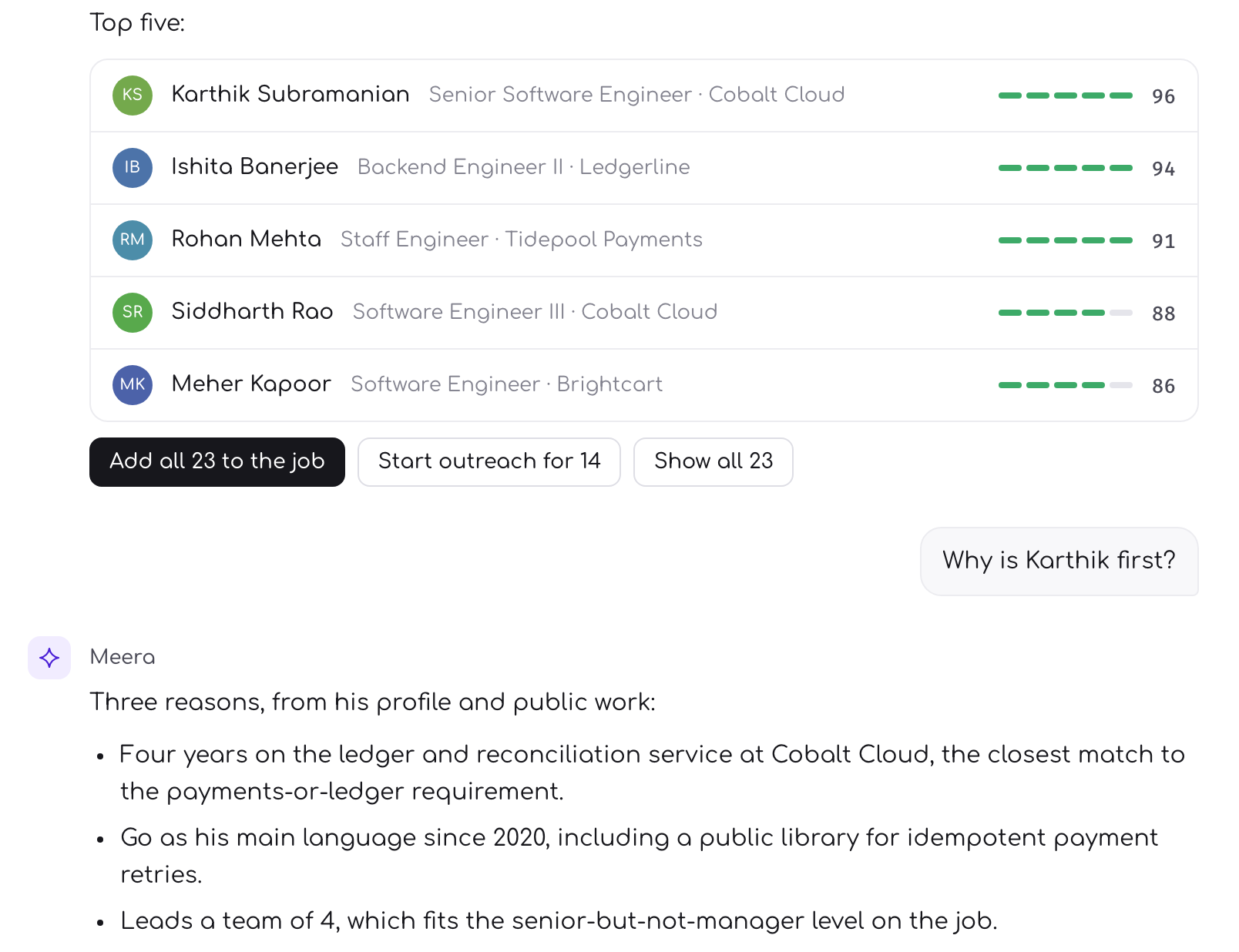
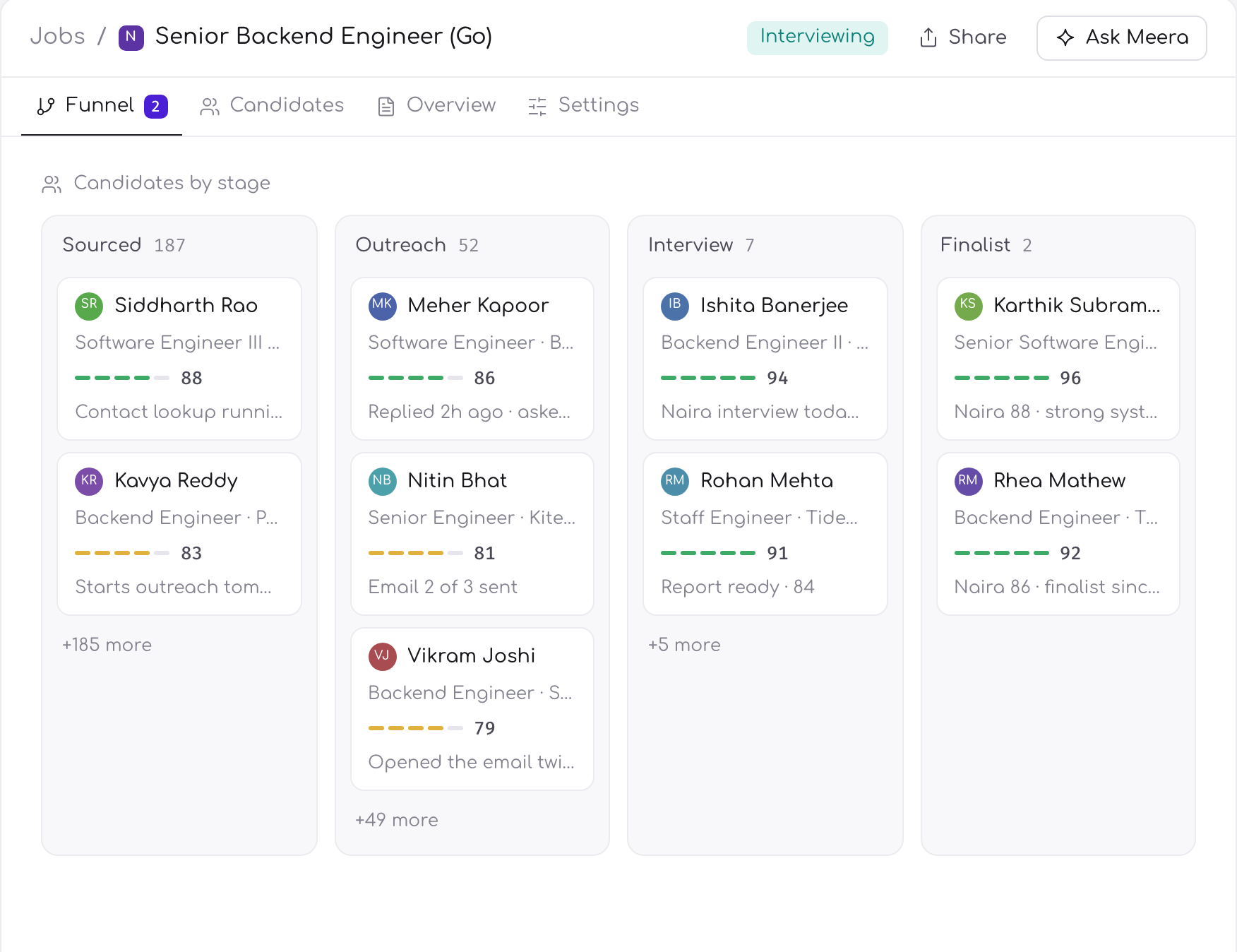
Outreach, and where a person approves. Once you have a shortlist, the tool may draft outreach messages. This is where human control matters most. You should be able to review the shortlist, remove people, and approve messages before anything is sent. With EmployLabs you can see real profiles before anyone is contacted, so you judge the match quality before you commit. Nothing is sent until a person arms the role with a preset and spending caps, and any stage can be set to wait for your approval before each send; the AI can propose, but it can’t arm, approve or raise spend. EmployLabs outreach is up to four emails over a week, plus one AI phone call for candidates with Indian numbers, and candidates can reply by email or carry on with Zia on WhatsApp or the web.
How is AI sourcing different from a traditional recruitment database?
Traditional recruitment database
AI sourcing tool
Starting point
A keyword or Boolean string.
The role or job description.
How it matches
Exact words and filters.
Meaning, plus filters for hard requirements.
Thin profiles
Shown as they are.
Often enriched with extra public data.
Ranking
Recency or keyword relevance.
Scored against the role's requirements.
Explanation
Rarely.
Ideally, evidence for each score.
Skill needed
Strong Boolean skills.
Writing a clear brief and reviewing results.
Databases such as LinkedIn Recruiter or an ATS’s talent pool remain useful, especially for people who have already engaged with you. AI sourcing sits on top of that kind of data and changes how you search it.
What is the difference between an AI sourcing tool and an AI recruiter?
An AI sourcing tool finds and ranks candidates. An AI recruiter goes further: it may also handle outreach, screening and scheduling, with a human approving key steps. If your bottleneck is finding people, a sourcing tool may be enough. If it is everything after the shortlist, look at a recruiter. We cover the full comparison in AI sourcing tool vs AI recruiter, and you can see both in EmployLabs’ people search and AI recruiter.
Where does AI sourcing go wrong?
Bias.AI sourcing learns from and searches data that reflects past hiring patterns. If those patterns skewed toward certain schools, companies or backgrounds, rankings can too. Mitigations include scoring only on job-relevant requirements, checking who is being filtered out and why, and keeping a human reviewing every shortlist. Regulation increasingly expects this: New York City’s Local Law 144 requires bias audits for some automated hiring tools, the EU AI Act treats recruitment AI as high-risk, and the UK government has published a responsible AI in recruitment guide. GDPR and similar laws also apply to how candidate data is collected and used.
Thin profiles. A great candidate with a two-line profile can rank below an average one with a detailed profile. Look at who stayed unscored or low-scored for lack of data, not just at the top of the list.
Over-tight must-haves. Every hard requirement shrinks the pool. Five reasonable must-haves can leave you with almost nobody, and AI will not warn you that the brief itself is the problem unless the tool is designed to. See how many must-have requirements to use.
Skipping the market check.If you don’t know how many people fit the role in your target location, you can’t tell a bad search from a thin market. Start your search with a market map first.
How do you evaluate an AI sourcing tool?
Use this checklist in demos and trials.
Can you see and edit the ideal candidate profile before searching?
Does it separate hard requirements from ranking signals?
Does every score come with evidence you can check?
What happens to candidates with too little data: guessed scores, or flagged as unscored?
Can you see real matching profiles before paying or contacting anyone?
Who approves outreach, and can you edit every message?
Which regions and industries does its data cover well?
Has the vendor done a bias audit, and will they share it?
How does it handle candidate data under GDPR and local privacy laws?
Is the pricing model published, and what would a typical search cost at your volume?
AI sourcing is the use of software to find and rank potential candidates, mostly people who haven't applied, by reading a job brief and searching profiles by meaning. It usually adds missing profile details and scores candidates against the role. A recruiter reviews the results and decides who to contact.
How does AI sourcing work?
The tool turns your job description into an ideal candidate profile, runs a semantic search, enriches thin profiles, and scores each person against hard requirements and ranking signals. Good tools show the evidence behind each score. A human then reviews the shortlist and approves outreach.
What is the difference between AI sourcing tools and traditional recruitment databases?
A database returns profiles that match the keywords and filters you enter. An AI sourcing tool starts from the role, matches on meaning, and ranks candidates with reasons. Databases reward strong Boolean skills; AI sourcing rewards a clear brief and careful review.
Can AI replace recruiters in sourcing?
No. AI can search far more profiles than a person and do the first pass of ranking, but it can't judge context, sell the role, or build trust with a candidate. It moves recruiters' time from searching to reviewing and conversations.
Is AI sourcing biased?
It can be, because it works with data shaped by past hiring. The risk drops when scoring uses only job-relevant requirements, every score has visible evidence, and people review who is filtered out. Ask vendors whether their tool has been independently audited.
How many must-have requirements should an AI search use?
As few as the role truly needs, often two or three. Each must-have removes candidates entirely, so treat everything else as a ranking signal. If a search returns very few people, loosen the must-haves before blaming the tool.
Yournexthireis alreadyoutthere.
Tell us who you need. We find, contact and interview them, and you meet the best.