Hi Anaya, a senior Go role on a payments team. Hybrid, with the salary band in the brief.
Anaya
Interesting. How many days in the office?
Zia
Three days in Bangalore. Want a voice interview this week?
Zia
Booked: interview Thursday 16:30
Naira report cardVoice · Naira
Maya Thompson·Applied for Collections Specialist·Interviewed Sep 27, 2026, 38 min
74.0/ 100 overall
AlignedIntegrity 96%English (CEFR) B2
Strongly not alignedAlignedStrongly aligned
“Clear, calm caller who secured a payment plan without pressure tactics; audit caught 4 of 5 compliance slips. Speaks fluently at a natural call pace.”
Handle a Customer Who Disputes a Past-Due Balance
M2Voice only
Module Score4.1 / 5
Strengths
Verified identity before discussing the balance
Offered a concrete 3-month plan unprompted
Weaknesses
Slight hesitation stating the exact due date
Did not repeat the total balance for confirmation
Evidence (transcript quotes)
“I understand this is frustrating — let's find a plan that works for you and confirm it today.”
You set how many finalists you want. Every other number is derived from it, and the conversion rates behind that arithmetic are replaced by your own as your hires accumulate.
EmployLabs asks a recruiter for one number, the finalist count, and derives every other figure in the funnel by running the conversion cascade backwards, widened or narrowed by how hard the role is. Early roles use general conversion assumptions; as an organisation's own hires accumulate, its measured conversion replaces them and the projections correct themselves.
Every funnel number starts as somebody else’s
Pipeline planning usually runs on borrowed figures. A reply rate from a conference talk, a screen-pass rate from an article, a rule of thumb a colleague brought from a previous employer. They are all averages of organisations you are not, and they are used because nothing better is to hand at the moment the planning happens.
The trouble is not that borrowed rates are wrong in some general sense. It is that the direction of the error is unknowable. Your employer brand, your function, the seniority you hire at and the market you hire in all move those rates, and they do not move them the same way. A borrowed number will size your pipeline incorrectly and give you no indication of which way it is off.
You set one number
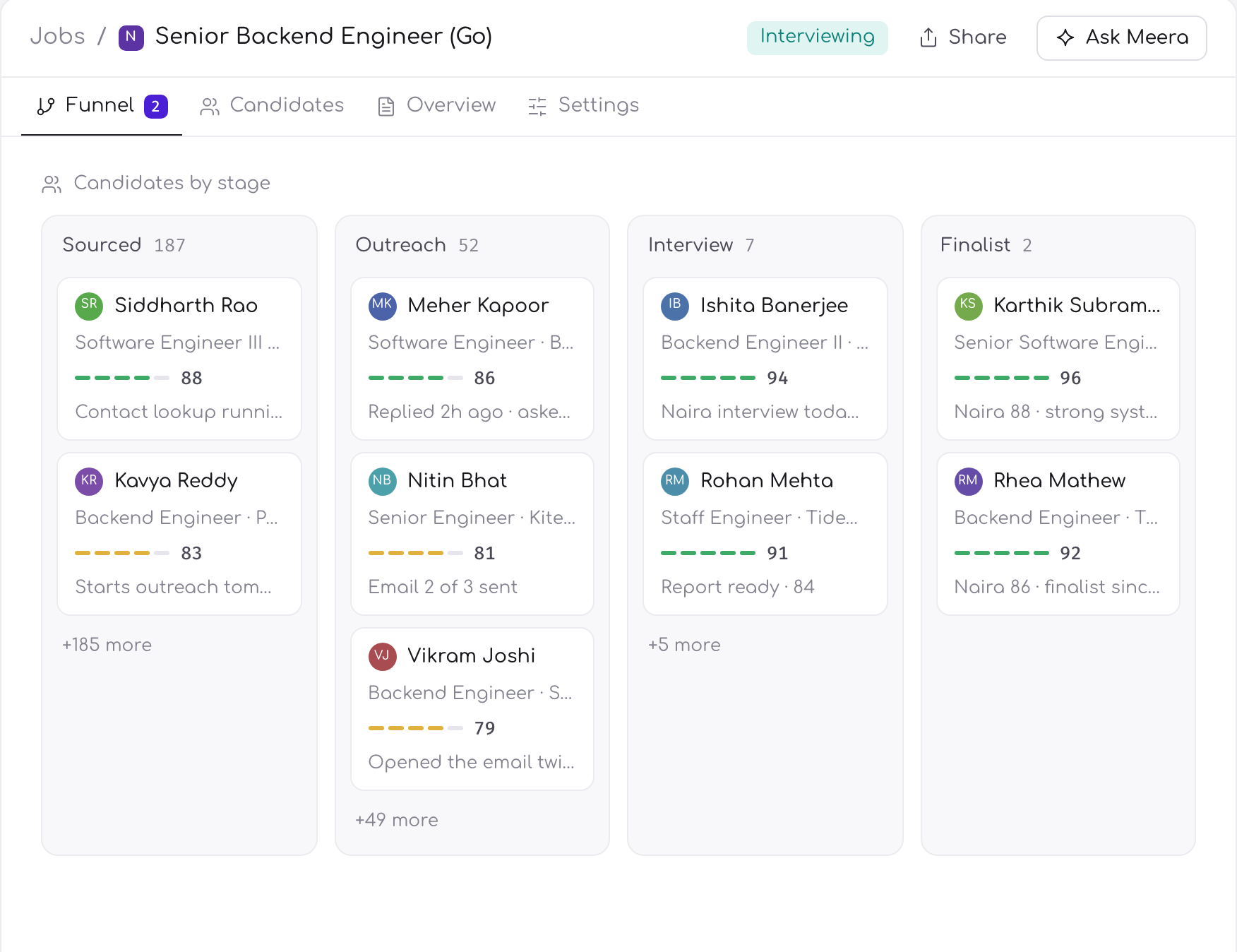
On EmployLabs you supply a single figure: how many finalists you want to end up with. Every other number in the funnel is derived from it by running the conversion cascade backwards, so nobody is asked how many profiles to source or how many people to contact. Those are consequences of the finalist target, not separate decisions.
How hard the role is to fill then widens or narrows the top of that funnel. Two roles wanting the same number of finalists do not need the same volume at the top if one of them is a commodity hire and the other exists in a handful of companies. The difficulty assessment widens or narrows the whole funnel by a single factor, so that difference is accounted for.
This is the part that is hardest to do by hand, because the relationship is not proportional. It is the stage conversion rates that compound: fewer people match, fewer of those who match reply, and fewer of those who reply are available. Small differences at each stage multiply into large differences in what the top of the funnel has to carry.
A benchmark is somebody else’s history. The only conversion rate that describes you is your own.
Then your own hiring replaces the assumptions
On the first roles, the cascade has to run on general assumptions, because there is nothing else to run on. That is worth saying plainly rather than leaving implied: the early projections are a hypothesis about your funnel, not a measurement of it.
As your own hires accumulate, those assumptions are replaced by what your organisation actually converts at. How many sourced candidates clear your bar, how many of those answer, how many of those come through an interview well. Each of those stops being an imported figure and becomes an observation about you.
Which means the projections correct themselves over time. Nobody sits down to recalibrate a planning spreadsheet, and nobody has to notice that the old assumption had drifted. The estimate for the next role is built from the evidence of the last ones, in the same way and without anyone deciding to do it.
There is also no moment you have to manage. It is not a switch from assumptions to measurement that someone throws once enough roles have run; the assumptions give way as the evidence arrives, in the places where evidence exists. That matters because the alternative — a recalibration project scheduled for a quiet month — is the kind of work that never reaches the top of anyone’s list, which is why most hiring plans are still sized on rates that were borrowed years ago and never revisited.
What this changes about trusting a projection
The numbers have a provenance. A derived target is a function of a finalist count, a difficulty assessment and a set of conversion rates, so disagreeing with it means disagreeing with one of those rather than with a figure that simply appeared.
Early projections should be held loosely. They are honest arithmetic on general assumptions, and the assumptions are the weak part.
Later projections are about your organisation. The same cascade, run on rates observed in your own hiring, is a materially different claim from the same cascade run on averages.
Improvements show up in the planning. If your outreach or your screening gets better, the measured conversion moves, and the next role is sized on the better rate rather than on the one you had when you started.
How to use it
Set the finalist count to what the hiring manager will genuinely sit through. It is the one input, so an inflated number inflates everything derived from it.
On early roles, read the derived figures as a starting hypothesis. They are the best available estimate and they are not yet evidence about you.
Keep running roles on the platform even when a particular search feels unusual. Every completed role is what turns the general assumptions into your own measured rates, and the unusual ones carry as much information as the ordinary ones.
Common questions
What do I actually have to tell the system about pipeline volume?
How many finalists you want. Sourcing, outreach and interview volumes are derived from that figure by working the conversion cascade backwards, and how hard the role is to fill widens or narrows the top of the funnel accordingly.
Where do the conversion rates come from before I have any history?
From general assumptions, which is stated rather than hidden. Early projections are honest arithmetic on borrowed rates, so they are a hypothesis about your funnel rather than a measurement of it, and they should be held loosely.
Do the projections get more accurate over time?
They correct themselves as your own hires accumulate, because the general assumptions are replaced by the conversion your organisation actually achieves. Nobody has to recalibrate anything by hand for that to happen.