Hi Anaya, a senior Go role on a payments team. Hybrid, with the salary band in the brief.
Anaya
Interesting. How many days in the office?
Zia
Three days in Bangalore. Want a voice interview this week?
Zia
Booked: interview Thursday 16:30
Naira report cardVoice · Naira
Maya Thompson·Applied for Collections Specialist·Interviewed Sep 27, 2026, 38 min
74.0/ 100 overall
AlignedIntegrity 96%English (CEFR) B2
Strongly not alignedAlignedStrongly aligned
“Clear, calm caller who secured a payment plan without pressure tactics; audit caught 4 of 5 compliance slips. Speaks fluently at a natural call pace.”
Handle a Customer Who Disputes a Past-Due Balance
M2Voice only
Module Score4.1 / 5
Strengths
Verified identity before discussing the balance
Offered a concrete 3-month plan unprompted
Weaknesses
Slight hesitation stating the exact due date
Did not repeat the total balance for confirmation
Evidence (transcript quotes)
“I understand this is frustrating — let's find a plan that works for you and confirm it today.”
Naira report cardVoice · Naira
Maya Thompson·Applied for Collections Specialist·Interviewed Sep 27, 2026, 38 min
74.0/ 100 overall
AlignedIntegrity 96%English (CEFR) B2
Strongly not alignedAlignedStrongly aligned
“Clear, calm caller who secured a payment plan without pressure tactics; audit caught 4 of 5 compliance slips. Speaks fluently at a natural call pace.”
Handle a Customer Who Disputes a Past-Due Balance
M2Voice only
Module Score4.1 / 5
Strengths
Verified identity before discussing the balance
Offered a concrete 3-month plan unprompted
Weaknesses
Slight hesitation stating the exact due date
Did not repeat the total balance for confirmation
Evidence (transcript quotes)
“I understand this is frustrating — let's find a plan that works for you and confirm it today.”
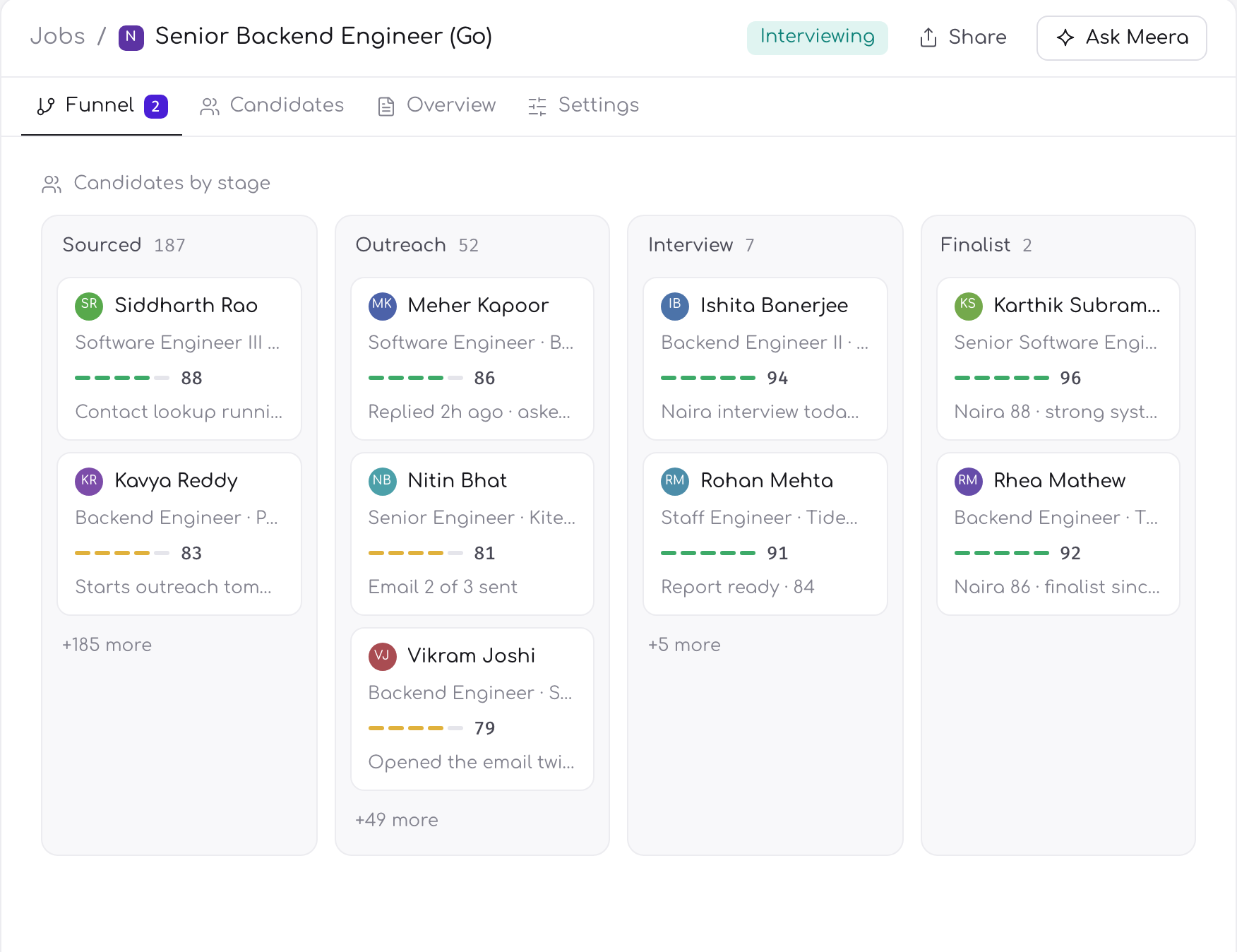
EmployLabs derives every pipeline stage from a single input: how many finalists the recruiter wants. Sourcing, outreach and interview volumes are back-calculated through the conversion at each stage and scaled by role difficulty. Starting rates are assumptions that get replaced by your own observed conversion once roles have history, and your spend cap always overrides the derived numbers.
Nobody knows how many people to source
Ask a recruiter how many candidates a role needs and the honest answer is that it depends on the role, and they will find out by running it. So the number gets set by whatever the tool defaults to, or by how much budget is left, and the pipeline is either starved or bloated for reasons nobody chose.
The number is derivable. It just requires working backwards from the only figure the recruiter actually knows.
One knob
You say how many finalists you want to end up with. Everything else is calculated from that: how many to source, how many to contact, how many to interview, all scaled by how hard this particular role is to fill.
A role needing three finalists is not a third of a role needing nine, because the conversion at each stage compounds. Running that cascade by hand is arithmetic nobody does, so in practice it gets guessed.
The only number a recruiter reliably knows is how many finalists they need.
And the targets correct themselves
The starting conversion rates are assumptions. Once your roles have history, your own observed rates take over: how many sourced candidates clear your bar, how many of those reply, how many of those interview well.
This matters most where intuition is worst. Reply rates vary enormously by function and seniority, and a rate imported from someone else’s benchmark will size your pipeline wrongly in a direction you cannot predict.
Stage
Set by hand
Derived from the finalist target
How many to source
A round number, or whatever the credit budget allows.
Back-calculated through every conversion, adjusted for role difficulty.
How many to contact
Usually everyone who cleared the bar.
Enough to produce the interviews the finalist count needs, and no more.
How many to interview
However many say yes.
Sized so the finalist count is met without burning interview slots.
When it is wrong
You find out at the end, having spent the budget.
The gap shows up as a stalled stage while there is still time to act.
What you still control
The ceiling. Derived targets propose; your spend cap disposes. Sourcing is free, so the cap bites on the stages that cost something, and it tells you when it does.
Any single stage. Override one number and the rest still derive around it.
The finalist count itself. Change it mid-role and everything downstream resizes.
How to use it
Set the finalist count to what the hiring manager will genuinely interview, not to what feels safe. Padding it multiplies through every stage.
Leave the derived numbers alone on the first role. They are a hypothesis, and overriding them before there is data replaces one guess with another.
Look at the derived source figure against your cap before arming. If the maths needs more than you will fund, that is worth knowing on day one rather than in week three.
Common questions
How many candidates do you need to source to make one hire?
It depends on the role's difficulty and your own conversion at each stage, which is why the number should be derived rather than guessed. Working backwards from the finalist count through sourcing, outreach and interview conversion gives a figure specific to your role.
What happens if the derived outreach target exceeds my budget?
The spend cap wins and you are told. Sourcing itself is free, so the ceiling bites on the stages that cost something, and a role whose maths requires more contact than you will fund surfaces that on day one rather than at the end.
Do the pipeline targets adjust over time?
Yes. Initial conversion rates are assumptions, and they are replaced by your organisation's own observed rates as roles accumulate history. This matters most for reply rates, which vary widely by function and seniority.