Hi Anaya, a senior Go role on a payments team. Hybrid, with the salary band in the brief.
Anaya
Interesting. How many days in the office?
Zia
Three days in Bangalore. Want a voice interview this week?
Zia
Booked: interview Thursday 16:30
Naira report cardVoice · Naira
Maya Thompson·Applied for Collections Specialist·Interviewed Sep 27, 2026, 38 min
74.0/ 100 overall
AlignedIntegrity 96%English (CEFR) B2
Strongly not alignedAlignedStrongly aligned
“Clear, calm caller who secured a payment plan without pressure tactics; audit caught 4 of 5 compliance slips. Speaks fluently at a natural call pace.”
Handle a Customer Who Disputes a Past-Due Balance
M2Voice only
Module Score4.1 / 5
Strengths
Verified identity before discussing the balance
Offered a concrete 3-month plan unprompted
Weaknesses
Slight hesitation stating the exact due date
Did not repeat the total balance for confirmation
Evidence (transcript quotes)
“I understand this is frustrating — let's find a plan that works for you and confirm it today.”
Naira report cardVoice · Naira
Maya Thompson·Applied for Collections Specialist·Interviewed Sep 27, 2026, 38 min
74.0/ 100 overall
AlignedIntegrity 96%English (CEFR) B2
Strongly not alignedAlignedStrongly aligned
“Clear, calm caller who secured a payment plan without pressure tactics; audit caught 4 of 5 compliance slips. Speaks fluently at a natural call pace.”
Handle a Customer Who Disputes a Past-Due Balance
M2Voice only
Module Score4.1 / 5
Strengths
Verified identity before discussing the balance
Offered a concrete 3-month plan unprompted
Weaknesses
Slight hesitation stating the exact due date
Did not repeat the total balance for confirmation
Evidence (transcript quotes)
“I understand this is frustrating — let's find a plan that works for you and confirm it today.”
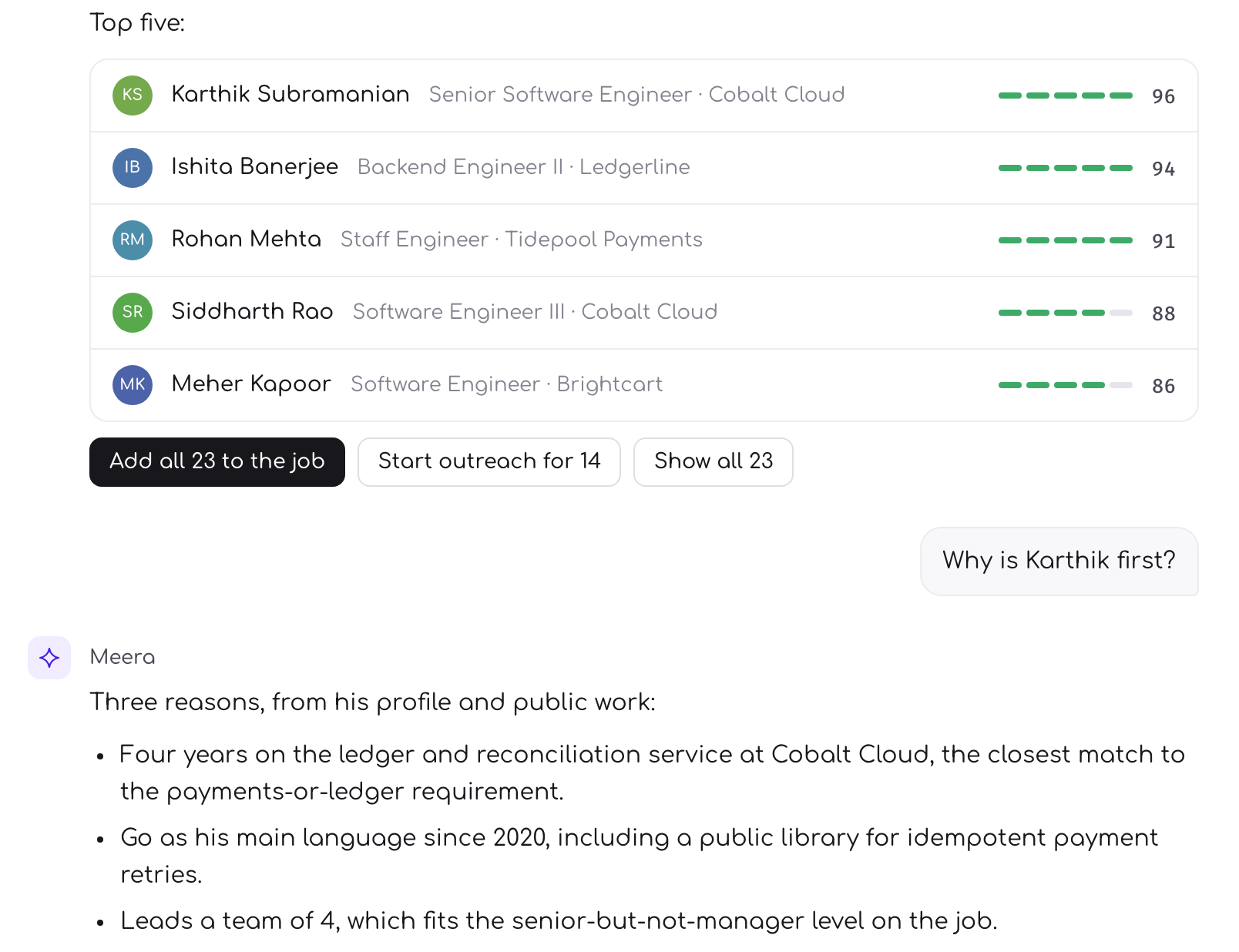
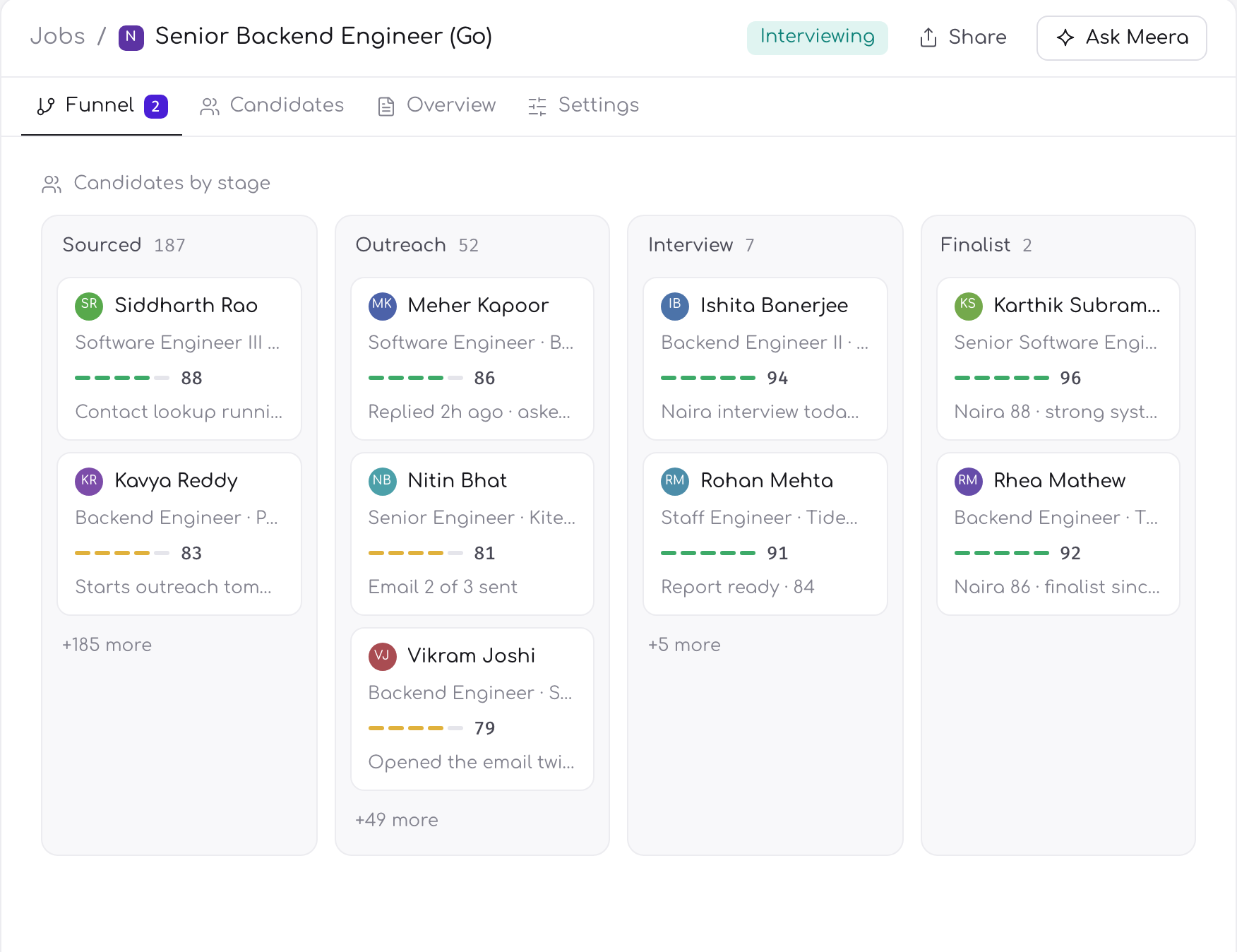
An AI recruiting agent pursues a hiring outcome by choosing its own steps and reacting to results, stopping at defined human gates. This differs from an assistant, which only suggests and requires you to act, and from automation, which executes a fixed configured sequence. The practical test: if two runs of the same brief could never legitimately differ, it is automation rather than an agent.
A word that stopped carrying information
In 2024 an AI recruiting tool meant a search box that understood a sentence. By 2026 the same phrase covers a scheduling bot, a chat widget, a screening product and a system that runs an entire hiring process, and buyers are expected to work out which one they are looking at from a homepage.
The distinction that actually matters is not how clever the model is. It is how much of the work happens without a person, and what happens at the points where a person is still required.
Assistant, automation, agent
What it does
How you can tell
Assistant
Answers, drafts and suggests. You act on every output.
Nothing happens if you close the tab.
Automation
Executes a fixed sequence you configured. Same steps, same order, every time.
It cannot decide to do something different, only to stop.
Agent
Pursues an outcome. Chooses steps, reacts to what comes back, and stops at defined gates.
Two runs of the same brief can legitimately look different.
Most products sold as agents are automations with a chat interface, which is not an insult. Automation is reliable and cheap and often the right purchase. It is only a problem when it is bought expecting judgement.
If two runs of the same brief could never differ, it is automation. That is fine. It is just not an agent.
What an agent must have to be trustworthy
Gates that refuse it. Anything that spends money or contacts a person needs a human decision, enforced in code rather than requested in a prompt.
Legible reasoning. If you cannot see why a candidate scored what they scored, you cannot supervise the agent, and unsupervised judgement is the thing you were worried about.
A stopping condition it announces. An agent that quietly halts is indistinguishable from a broken one.
Bounded spend. Autonomy over money without a ceiling is not a feature.
Where agents genuinely help in hiring
The work that is high-volume, judgement-light and time-sensitive. Finding candidates against a described profile. Reaching out and following up on a schedule nobody keeps manually. Answering the same twenty questions at whatever hour they arrive. Running a structured screen consistently across forty people. Chasing an assessment.
None of that is the interesting part of recruiting. All of it is most of the hours.
Where they do not
Persuading a hesitant candidate. Telling a hiring manager their brief is unrealistic. Deciding which of two good finalists fits a team. Anything where the answer depends on context that lives in your company rather than in a profile.
A vendor who claims otherwise is describing a liability, and the honest ones name their limits without being asked.
How to evaluate one
Ask what it does without a human, and expect a short specific list rather than a philosophy.
Ask to see the reasoning behind one decision it made.
Go through the candidate experience yourself, including declining.
Ask what stops it spending, and what a refusal costs.
Ask what you keep if you stop paying.
Common questions
What is the difference between an AI assistant, automation and an AI agent in recruiting?
An assistant suggests and you act on every output. Automation executes a fixed sequence you configured, in the same order every time. An agent pursues an outcome, choosing steps and reacting to what comes back, stopping at defined human gates.
How can you tell if a product is really an AI agent?
Ask whether two runs of the same brief could legitimately produce different sequences of action. If they could not, it is automation with a chat interface, which is often the right purchase but should not be bought expecting judgement.
What must an AI recruiting agent have to be trustworthy?
Gates that refuse it enforced in code rather than prompts, reasoning you can inspect, a stopping condition it announces rather than halting silently, and a hard ceiling on spend.
What should an AI recruiting agent not be trusted with?
Persuading a hesitant candidate, telling a hiring manager their brief is unrealistic, and choosing between two good finalists. These depend on context that lives inside your company rather than in a candidate profile.